Effective note-taking is one of the most important academic and professional skills you can develop. Among the many strategies available, Cornell notes stand out as one of the most structured, practical, and research-supported methods. Developed at Cornell University, this system transforms ordinary notes into a powerful learning tool that improves comprehension, organization, and long-term retention. In this comprehensive guide, you’ll learn what Cornell notes are, how the system works, why it is effective, and how you can use it to dramatically improve your study and productivity habits.
What Are Cornell Notes?
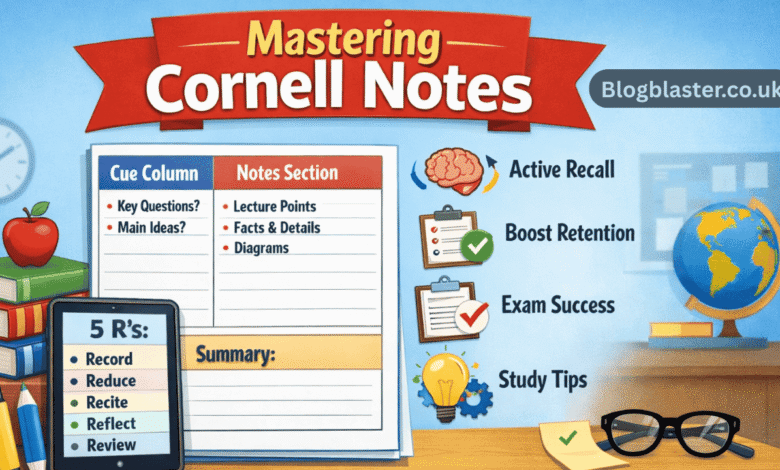
Cornell notes are a structured note-taking method that divides a page into three specific sections:
- Cue Column (Left Side)
- Notes Section (Right Side)
- Summary Section (Bottom)
This layout encourages active engagement with material rather than passive transcription. The method was developed in the 1950s by Walter Pauk, a professor at Cornell University, to help students study more efficiently.
Unlike traditional note-taking, where information is written in long paragraphs, the Cornell note-taking system creates a built-in review process. Students not only record information but also analyze, summarize, and test themselves.
The Structure of Cornell Notes
Understanding the format is essential to using Cornell notes effectively.
Notes Section (Right Column)
This is the largest section of the page. During lectures, meetings, or while reading, you record key points, facts, diagrams, and explanations here.
Tips for this section:
- Use bullet points
- Write short phrases instead of full sentences
- Highlight main ideas
- Leave space between topics
The goal is to capture essential information clearly and concisely.
Cue Column (Left Column)
After the lecture or reading session, you return to your notes and create keywords, questions, or prompts in the left column.
These cues help you:
- Test your memory
- Identify key themes
- Organize concepts
- Prepare for exams
For example, if your notes discuss photosynthesis, your cue might be:
- “What is photosynthesis?”
- “Stages of photosynthesis?”
- “Why is sunlight necessary?”
This column transforms your notes into a study guide.
Summary Section (Bottom)
At the bottom of the page, you compose a brief summary (usually 3–5 sentences) of the entire page.
The summary helps:
- Reinforce understanding
- Improve long-term retention
- Clarify the main idea
- Connect concepts together
This step is often skipped, but it is one of the most powerful parts of the Cornell note-taking method.
How to Use the Cornell Note-Taking System (Step-by-Step)
The Cornell notes system follows what is often called the “5 R’s” process:
Record
Write detailed notes in the right-hand column during class or while reading.
Reduce
Soon after the session, review your notes and write keywords or questions in the cue column.
Recite
Cover the right column and attempt to answer the questions from the cue column out loud.
Reflect
Think about how the information connects to previous knowledge or real-life applications.
Review
Spend 5–10 minutes each week reviewing your Cornell notes to strengthen memory.
This built-in review cycle is what makes Cornell notes more effective than traditional note-taking methods.
Why Cornell Notes Are So Effective
The success of Cornell notes is not accidental. It aligns with proven cognitive science principles.
Encourages Active Learning
Instead of copying information word-for-word, you process and summarize it. Active engagement improves understanding.
Supports Active Recall
The cue column forces you to retrieve information from memory. Research shows active recall significantly improves retention.
Promotes Spaced Repetition
Regularly reviewing your notes strengthens neural pathways and helps transfer knowledge into long-term memory.
Improves Organization
The structured format makes it easier to:
- Find key concepts quickly
- Prepare for exams
- Organize complex topics
Enhances Critical Thinking
Writing your own questions in the cue column encourages analysis rather than memorization.
Benefits of Using Cornell Notes
Here are some key benefits of using the Cornell note-taking method:
- Better exam preparation
- Increased comprehension
- Stronger memory retention
- Cleaner, more organized notes
- Reduced study time
- Improved focus during lectures
- Built-in self-testing system
Students who consistently use Cornell notes often report improved grades and greater confidence in exams.
Cornell Notes vs. Other Note-Taking Methods
Let’s compare Cornell notes with other popular methods.
Cornell Notes vs. Outline Method
The outline method organizes notes hierarchically but lacks a built-in review system. Cornell notes add active recall and summarization.
Cornell Notes vs. Mind Mapping
Mind maps are visual and creative, but can become cluttered. Cornell notes offer a clearer structure and easier revision.
Cornell Notes vs. Charting Method
Charts are useful for comparisons but not ideal for narrative lectures. Cornell notes are more flexible.
Overall, Cornell notes are more comprehensive because they combine recording, organization, and review into a single system.
Cornell Notes Example (Practical Illustration)
Imagine you are taking notes on World War II.
Right Column (Notes Section):
- World War II started in 1939
- Germany invaded Poland
- Allied Powers vs Axis Powers
- Ended in 1945
- Atomic bombs were detonated on Hiroshima and Nagasaki.
Left Column (Cue Column):
- When did WWII start?
- Who invaded Poland?
- Who were the Allied Powers?
- When did WWII end?
- What ended the war?
Summary Section:
World War II was a global conflict from 1939 to 1945 involving the Allied and Axis powers. It began with Germany’s invasion of Poland and ended after the atomic bombings of Japan.
This layout turns simple notes into a powerful study tool.
Digital Cornell Notes
You can use Cornell notes digitally in:
- Microsoft OneNote
- Notion
- Google Docs
- Evernote
- iPad note-taking apps
- PDF templates
Digital Cornell notes allow you to:
- Add hyperlinks
- Insert images
- Search keywords
- Sync across devices
Many students now combine handwritten Cornell notes with digital review systems for maximum effectiveness.
Who Should Use Cornell Notes?
The Cornell note-taking system is ideal for:
- High school students
- College students
- Graduate students
- Law and medical students
- Teachers
- Researchers
- Professionals in meetings
- Online course learners
It works especially well for lecture-heavy subjects like history, biology, psychology, economics, and law.
Common Mistakes to Avoid
To get the most out of Cornell notes, avoid these mistakes:
Writing Too Much
Don’t transcribe everything. Focus on key ideas.
Skipping the Cue Column
This is where active recall happens. Don’t ignore it.
Ignoring the Summary
The summary consolidates learning.
Not Reviewing Regularly
Cornell notes only work if you revisit them.
Tips for Maximizing Cornell Notes Effectiveness
- Review notes within 24 hours.
- Use questions in the cue column instead of just keywords.
- Color-code important ideas.
- Add diagrams in the notes section.
- Keep summaries concise but meaningful.
- Use weekly review sessions.
Consistency is more important than perfection.
Research on Cornell Notes
Educational research suggests structured note-taking improves comprehension and recall. While individual results may vary, studies indicate that:
- Students who generate questions perform better in exams.
- Active recall strengthens long-term memory.
- Summarization improves conceptual understanding.
Cornell notes combine all three elements, which explains their continued popularity in educational institutions worldwide.
Frequently Asked Questions About Cornell Notes
What are Cornell notes used for?
Cornell notes are used to organize lecture material, improve memory retention, and prepare for exams through structured review.
Are Cornell notes good for all subjects?
Yes. They are especially effective for theoretical subjects but can also be adapted for math and science by including worked examples.
Should Cornell notes be handwritten or digital?
Both methods work. Handwriting may improve memory retention, while digital notes offer convenience and searchability.
How long should the summary be?
Typically, 3–5 sentences summarizing the main ideas of the page.
How often should I review Cornell notes?
At least once per week for optimal retention.
Final Thoughts
The Cornell notes system remains one of the most effective and widely recommended note-taking strategies for a reason. By combining structured organization, active recall, and summarization, Cornell notes transform passive information into meaningful learning.
You May Also Read: Courseto: The Smart Way to Learn, Grow, and Build Real-World Skills Online