Electric vehicles have changed the way drivers think about efficiency, performance, and daily usability. Instead of focusing only on fuel economy, EV owners pay close attention to range, battery usage, and driving behavior. One common question among Cadillac LYRIQ shoppers and owners is: do the driving modes in Cadillac LYRIQ offer different ranges or battery usages? The short answer is yes—but indirectly. The driving modes in the Cadillac LYRIQ do not physically change the battery’s size or officially rate different EPA ranges. However, they do alter how the vehicle responds to driver inputs, how power is delivered, and how traction systems behave. These changes can meaningfully influence real-world energy consumption and range. This article takes an in-depth look at how the Cadillac LYRIQ’s driving modes work, what they change, and how each mode can affect battery usage and driving range in everyday conditions.
Understanding the Cadillac LYRIQ Driving Modes
Before diving into efficiency and range, it’s important to understand what driving modes actually do in the Cadillac LYRIQ. Like many modern EVs, the LYRIQ uses software-based tuning to adjust vehicle behavior rather than mechanical changes.
Standard Driving Modes in the Cadillac LYRIQ
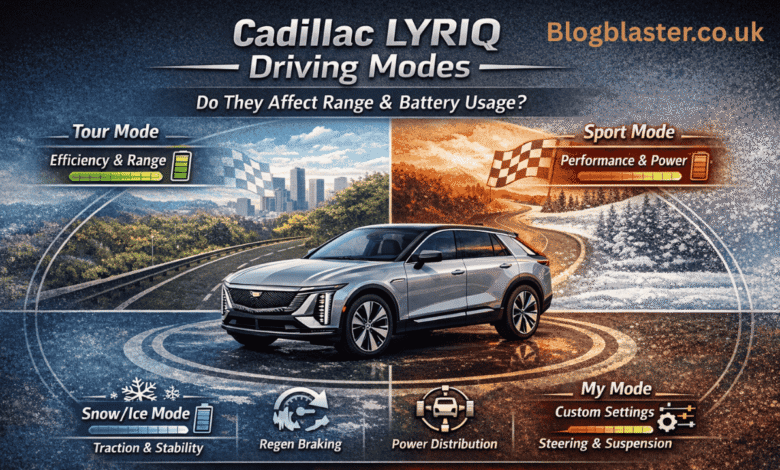
Most Cadillac LYRIQ trims include the following modes:
- Tour Mode
- Sport Mode
- Snow/Ice Mode
- My Mode (Customizable)
Each mode is designed for a specific driving environment or preference. While none of these modes explicitly state an official range difference, the way they manage power delivery can change how quickly energy is used.
How Driving Modes Affect Battery Usage in EVs
To answer the question do the driving modes in Cadillac LYRIQ offer different ranges or battery usages?, we need to understand how EV efficiency works.
Battery usage in an electric vehicle is influenced by several factors:
- Throttle response and acceleration behavior
- Regenerative braking strength
- Power distribution (especially in AWD models)
- Steering and suspension tuning (which can affect driving style)
- Driver behavior encouraged by the mode
Driving modes influence many of these factors, which is why range can vary even if the battery itself stays the same.
Tour Mode: Optimized for Efficiency and Comfort
What Tour Mode Does
Tour Mode is the default and most balanced driving mode in the Cadillac LYRIQ. It is designed for everyday driving, including commuting, highway cruising, and city use.
Key characteristics include:
- Smooth and progressive throttle response
- Balanced steering effort
- Comfort-focused suspension tuning (if equipped)
- Predictable power delivery
Impact on Range and Battery Usage
Tour Mode is generally the most efficient mode for most drivers. Because throttle response is gentler and power delivery is smoother, drivers are less likely to accelerate aggressively, which reduces energy draw from the battery.
In real-world driving, Tour Mode typically results in:
- Lower peak power usage
- More consistent efficiency
- Better overall driving range
For drivers focused on maximizing range, Tour Mode is usually the best choice.
Sport Mode: Performance Over Efficiency
What Sport Mode Changes
Sport Mode is designed to make the LYRIQ feel more dynamic and engaging. It enhances performance characteristics rather than efficiency.
Changes typically include:
- Sharper throttle response
- Heavier steering feel
- More aggressive acceleration
- Sportier suspension tuning (if equipped)
Impact on Range and Battery Usage
Sport Mode does not reduce battery capacity, but it encourages driving behavior that uses more energy.
Aggressive acceleration requires higher battery power output, which increases consumption. As a result:
- The battery drains faster during spirited driving
- Regenerative braking benefits may be reduced due to driving style
- Real-world range can drop noticeably
So, while Sport Mode does not officially “lower range,” it can absolutely result in shorter driving distances per charge compared to Tour Mode.
Snow/Ice Mode: Traction First, Efficiency Second
Purpose of Snow/Ice Mode
Snow/Ice Mode is designed for low-traction conditions such as snow-covered or icy roads. Safety and control take priority over performance or efficiency.
This mode typically adjusts:
- Throttle sensitivity to reduce wheel spin
- Traction and stability control systems
- Power delivery to wheels (especially on AWD models)
How It Affects Battery Usage
Snow/Ice Mode can be slightly less efficient depending on conditions. The vehicle may:
- Limit sudden power spikes
- Redistribute power to maintain traction
- Use additional energy to manage stability systems
However, because the throttle response is usually softened, Snow/Ice Mode does not always consume more energy than Sport Mode. In fact, during steady driving on slippery roads, efficiency may remain reasonable.
That said, Snow/Ice Mode is not designed for maximizing range and should primarily be used when safety demands it.
My Mode: Custom Settings and Personalized Efficiency
What Is My Mode?
My Mode allows drivers to customize various vehicle characteristics, including:
- Acceleration feel
- Steering response
- Brake feel
- Suspension behavior (if equipped)
- Motor sound enhancement
Can My Mode Improve Range?
Yes—depending on how it’s configured.
If a driver customizes My Mode to mimic or soften Tour Mode settings (gentle acceleration, relaxed steering), it can be just as efficient as Tour Mode. On the other hand, a performance-oriented My Mode may use even more energy than Sport Mode.
My Mode gives drivers flexibility, but efficiency ultimately depends on the settings and driving habits chosen.
Regenerative Braking and One-Pedal Driving
Role in Battery Efficiency
Beyond driving modes, features such as regenerative braking and One-Pedal Driving significantly affect battery usage.
- Regenerative braking recaptures energy when slowing down
- One-Pedal Driving maximizes regeneration in city driving
Using these features consistently can increase efficiency regardless of driving mode. Even in Sport Mode, effective regenerative braking can help offset higher energy consumption.
Does AWD vs RWD Change the Answer?
Yes, drivetrain configuration matters when asking do the driving modes in Cadillac LYRIQ offer different ranges or battery usages?
- RWD models tend to be slightly more efficient overall
- AWD models may consume more energy due to powering two motors
Driving modes that actively manage torque distribution in AWD models can affect battery usage more than in RWD models.
Real-World Factors That Matter More Than Driving Modes
While driving modes matter, they are not the only—or even the biggest—factor affecting range. Other important elements include:
- Speed (highway driving uses more energy)
- Weather and temperature
- Tire pressure and road conditions
- Payload and cargo weight
- Driver acceleration habits
Driving modes shape behavior, but how you drive matters more than the mode itself.
Practical Tips to Maximize Range in the Cadillac LYRIQ
If maximizing range is your priority:
- Use Tour Mode for daily driving
- Avoid aggressive acceleration, especially in Sport Mode
- Enable One-Pedal Driving in city traffic
- Precondition the cabin while plugged in
- Maintain steady highway speeds
These habits will often make a bigger difference than switching between modes alone.
Conclusion
So, do the driving modes in Cadillac LYRIQ offer different ranges or battery usages?
The answer is yes, but indirectly. Driving modes do not change the battery size or official EPA range, but they significantly influence how power is delivered, how the vehicle responds, and how drivers behave behind the wheel. Tour Mode generally offers the best efficiency, Sport Mode prioritizes performance at the cost of higher energy usage, Snow/Ice Mode focuses on safety, and My Mode allows drivers to tailor the balance themselves.
You May Also Read: Splitsecnd: The Revolutionary Vehicle Safety Device for Modern Drivers