Most warehouses still rely on traditional cameras that only record incidents after the damage is done. Theft is discovered the next morning. Safety violations are reviewed days later. And security teams spend hours scrubbing footage just to find one critical moment.
The promise of AI is different.
AI-powered warehouse security systems are shifting from passive recording to real-time detection, intelligent alerts, and operational visibility. Instead of simply capturing video, these systems analyze behavior, detect anomalies, and help teams respond within seconds.
With global supply chains under pressure and cargo theft rising, the stakes are high. According to CargoNet, U.S. cargo theft incidents increased by 57% year-over-year in 2023, with warehouses and distribution centers being primary targets. Meanwhile, OSHA reports that warehousing has one of the highest injury rates in the logistics sector, with a Total Recordable Incident Rate (TRIR) higher than the national average.
AI is stepping in to address both security and safety at scale.
Below are six specific, data-backed ways AI is transforming warehouse security systems in 2026.
1. Real-Time Intrusion Detection Instead of After-the-Fact Review
Traditional warehouse surveillance systems record continuously, but they rely on human review. This creates delay. If an intrusion happens at 2 a.m., it may not be discovered until shift change.
AI changes this dynamic.
Modern AI-enabled warehouse security systems can:
- Detect unauthorized access after hours
- Identify unusual movement patterns near restricted zones
- Trigger instant alerts when perimeter lines are crossed
- Distinguish between vehicles, humans, and environmental motion
This reduces false alarms significantly. Industry studies show that traditional motion-based systems can generate up to 95% false alerts in outdoor environments due to wind, animals, or lighting changes. AI models trained on object recognition dramatically reduce these false positives by understanding context.
For large facilities spanning hundreds of thousands of square feet, this capability reduces dependency on constant manual monitoring and shortens response time from hours to seconds.
2. AI-Driven Theft and Loss Prevention
Shrinkage remains a massive problem in warehousing and distribution. The National Retail Federation reports that U.S. retail shrink exceeded $112 billion in 2022, and warehouses are a critical link in that chain.
AI supports loss prevention in three measurable ways:
A. Behavioral Pattern Detection
AI can detect:
- Repeated loitering near high-value inventory
- Suspicious vehicle movements in loading docks
- Unusual after-hours activity inside storage areas
B. License Plate Recognition
Advanced systems identify vehicles entering and exiting facilities, allowing warehouses to maintain searchable logs tied to timestamps.
C. Searchable Video
Instead of reviewing hours of footage manually, security teams can search for specific descriptors such as “red forklift near Dock 3” or “person in high-vis vest near pallet racks.”
For example, modern warehouse security camera systems like those offered by Coram connect existing IP cameras to cloud-based analytics. This enables security teams to monitor multiple warehouse locations from a centralized dashboard, receive AI-generated alerts in real time, and quickly search video footage using text-based prompts. Features such as vehicle detection, license plate scanning, and customizable alert walls help reduce investigation time dramatically.
The key shift is operational: security teams no longer spend hours searching for incidents. They respond to alerts.
3. Worker Safety Monitoring and OSHA Compliance
Warehouse injuries remain a serious concern. According to the U.S. Bureau of Labor Statistics, warehousing and storage reported an injury rate of 4.8 cases per 100 full-time workers, compared to a national average of 2.7.
AI-powered warehouse security systems now assist with:
- Forklift safety monitoring
- Restricted zone enforcement
- Personal protective equipment (PPE) detection
- Slip-and-fall incident documentation
Forklift Collision Prevention
AI can detect unsafe proximity between forklifts and pedestrians, triggering alerts before collisions occur.
PPE Compliance
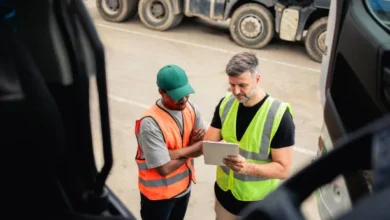
Computer vision models can identify whether workers are wearing high-visibility vests or helmets in designated areas.
Incident Documentation
If an injury occurs, AI-tagged footage allows safety teams to quickly review events, reducing insurance disputes and claim investigation time.
This is not about surveillance for discipline. It is about reducing injury risk and improving workplace standards.
4. Intelligent Perimeter Security for Large Facilities
Warehouses often span several acres with multiple access points. Traditional perimeter systems rely on fixed sensors or security guards, which can be expensive and inconsistent.
AI-powered systems enhance perimeter security by:
- Creating virtual tripwires
- Detecting fence climbing or tampering
- Monitoring blind spots at night
- Automatically escalating alerts based on threat level
Thermal imaging integrated with AI is increasingly common in high-value logistics hubs. Thermal cameras detect heat signatures, and AI distinguishes between animals, authorized vehicles, and human intruders.
This is particularly important given that logistics real estate vacancy rates in the U.S. have remained below 5% in recent years, meaning facilities are operating at high capacity and often handling high-value goods.
5. Centralized Multi-Site Management
Large enterprises may operate 10, 50, or even 200 warehouse locations. Managing these sites individually creates inconsistency and blind spots.
AI-driven warehouse security systems centralize operations by:
- Providing one dashboard for all locations
- Standardizing alert protocols
- Allowing role-based access control
- Enabling remote investigations
Instead of each warehouse operating independently, security teams gain enterprise-level visibility.
This is particularly valuable as e-commerce continues to grow. According to the U.S. Census Bureau, e-commerce sales accounted for over 15% of total retail sales in recent quarters, driving increased demand for distributed warehouse networks.
Centralized AI monitoring supports consistent security policies across all sites.
6. Operational Intelligence Beyond Security
One of the most overlooked benefits of AI in warehouse security systems is operational insight.
AI-generated data can support:
- Traffic flow analysis in loading bays
- Dock utilization optimization
- Shift pattern analysis
- Equipment movement tracking
While security is the primary objective, AI-driven analytics also help warehouse managers improve efficiency.
For example:
- Identifying congestion points near staging areas
- Monitoring loading times per dock
- Detecting bottlenecks in pallet movement
This dual-purpose functionality turns security infrastructure into a data asset rather than just a cost center.
What Makes AI Warehouse Security Systems Different from Traditional CCTV?
The difference is not resolution or storage. It is intelligence.
Traditional CCTV:
- Records everything
- Requires manual review
- Reacts after incidents
AI-powered systems:
- Analyze video in real time
- Flag only relevant events
- Reduce false alarms
- Shorten response times
The shift is from passive documentation to proactive protection.
Key Takeaways
- Cargo theft is rising, with reported increases of over 50% year-over-year in recent industry reports.
- AI reduces false alarms by analyzing context rather than raw motion.
- Warehouse injury rates remain higher than the national average, and AI supports safety compliance.
- Centralized dashboards allow enterprises to monitor multiple warehouse locations efficiently.
- AI-driven video search significantly reduces investigation time.
- Modern warehouse security systems combine perimeter monitoring, worker safety, and operational intelligence in one platform.
The Bigger Question: Are Warehouses Ready for AI-First Security?
The technology is available. The data supports its effectiveness. The real question is whether warehouses are prepared to shift from reactive security to proactive intelligence.
AI in warehouse security is no longer experimental. It is being deployed across logistics hubs, fulfillment centers, and distribution networks worldwide.
As supply chains grow more complex and facilities handle higher volumes of goods, the need for faster detection, smarter monitoring, and centralized oversight becomes unavoidable.
What changes have you seen in warehouse security over the past few years? Are you still relying on traditional surveillance, or has your facility started adopting AI-powered systems?