TriLift vs Other Facial Tightening Devices Clinical Comparison: Results, Technology, Safety and Evidence

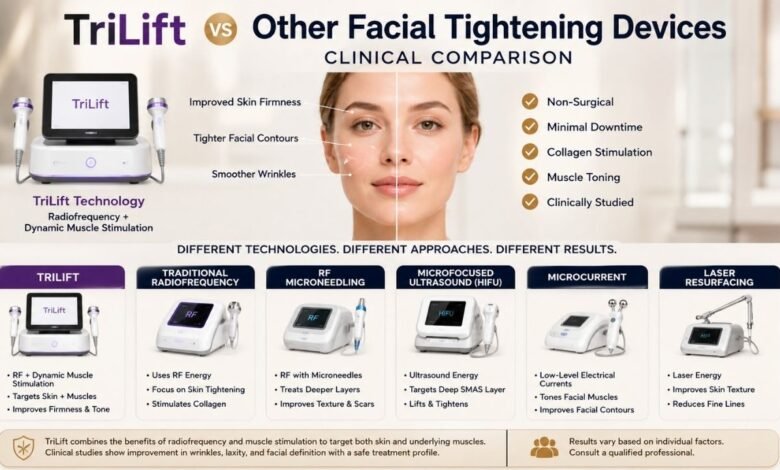
The demand for non-surgical facial tightening treatments has grown as people seek to address skin laxity, wrinkles, and facial definition without undergoing traditional cosmetic surgery. Among the technologies attracting attention is TriLift, a facial rejuvenation system that combines radiofrequency energy with Dynamic Muscle Stimulation. This combination has led to growing interest in how TriLift compares with other popular facial-tightening technologies.
The phrase Trilift vs other facial tightening devices clinical comparison is particularly relevant for people researching whether TriLift offers meaningful advantages over radiofrequency treatments, RF microneedling, microfocused ultrasound, microcurrent, and other aesthetic technologies.
However, making a fair comparison requires looking beyond marketing claims. Different devices work at different tissue depths and use different mechanisms. Clinical evidence also varies considerably between technologies. TriLift has been investigated in clinical studies for the treatment of facial wrinkles and laxity. Still, there is currently limited evidence from large randomized head-to-head trials proving that it produces better results than any competing technology.
This article examines the technology behind TriLift, its clinical evidence, and how it compares with other facial tightening options.
What Is TriLift?
TriLift is a non-surgical facial rejuvenation technology designed to address signs of facial aging. Its approach combines radiofrequency energy with Dynamic Muscle Stimulation (DMSt).
Radiofrequency is used to deliver controlled thermal energy into the skin and underlying tissues. The resulting heating can encourage collagen remodeling and may improve the appearance of skin firmness over time.
Dynamic Muscle Stimulation takes a different approach. Rather than relying solely on heat, it uses electrical stimulation to activate facial muscles. The goal is to create a more toned and lifted appearance.
The system can also be associated with fractional radiofrequency technology for certain skin-resurfacing applications. This means TriLift should not necessarily be considered a single treatment mechanism. Depending on the configuration and treatment plan, different technologies can address different aspects of facial aging.
How Does TriLift Work?
The primary TriLift approach combines two mechanisms: radiofrequency heating and electrical muscle stimulation.
Radiofrequency energy generates controlled heat within targeted tissue. Heat can influence collagen fibers and stimulate remodeling processes. Over time, this may contribute to improvements in firmness and skin texture.
Dynamic Muscle Stimulation is intended to stimulate facial muscles. This is particularly interesting because many facial rejuvenation technologies primarily focus on the skin rather than muscle activity.
The combination theoretically allows treatment to address both the skin’s appearance and the underlying facial musculature.
The exact experience and results can depend on the treatment protocol, device settings, number of sessions, patient’s age, degree of laxity, skin condition, and other individual factors.
TriLift Clinical Evidence
Clinical evidence is an important consideration when comparing cosmetic technologies.
A registered clinical study, NCT05773924, investigated TriLift for the treatment of facial wrinkles and skin laxity. The study used a prospective, open-label, single-arm design and planned to enroll approximately 25 participants.
This type of research can provide useful information about whether a treatment produces changes. However, it has an important limitation: there is no competing treatment group.
Without a randomized comparison group, researchers cannot confidently conclude that TriLift is superior to another device.
Another registered study, NCT05945069, investigated Dynamic Muscle Stimulation and radiofrequency technology for lower-eyelid laxity and blink quality among participants with dry-eye disease. While this adds information about the technology, it should not automatically be interpreted as evidence of superior facial lifting.
Consequently, TriLift can be described as a technology backed by clinical investigation. Still, its evidence base should not be presented as equivalent to decades of research spanning every other facial-tightening technology.
TriLift vs Radiofrequency Treatments
Traditional radiofrequency facial treatments are among the most established non-invasive approaches to skin tightening.
Like TriLift, conventional RF treatments use controlled heat to affect tissues beneath the skin. The heating process can encourage collagen contraction and remodeling.
The major difference is that TriLift adds Dynamic Muscle Stimulation to its RF approach.
This creates an interesting distinction. Traditional RF primarily targets thermal effects in tissue, whereas TriLift aims to combine thermal treatment with facial muscle stimulation.
That does not necessarily mean TriLift produces better results. Instead, it means the treatment is designed to address facial aging through multiple mechanisms.
For people primarily concerned with mild skin laxity and collagen remodeling, conventional RF may be sufficient. People interested in a combination approach may consider TriLift, subject to a professional assessment.
TriLift vs RF Microneedling
RF microneedling combines microneedles with radiofrequency energy. Tiny needles penetrate the skin while delivering RF energy at controlled depths.
This approach can produce stronger dermal remodeling than many completely non-invasive RF treatments. It is frequently considered for concerns such as skin laxity, wrinkles, uneven texture, and acne scarring.
The trade-off is that RF microneedling is minimally invasive. Patients can experience redness, swelling, tenderness, or other temporary reactions after treatment.
TriLift’s non-invasive RF and muscle-stimulation approach may appeal to people who prioritize minimal downtime.
RF microneedling may be more appropriate when deeper dermal remodeling or texture improvement is a major goal.
Therefore, the choice is not simply about which device is “stronger.” It is about what anatomical layer and cosmetic concern the treatment is intended to address.
TriLift vs HIFU and Microfocused Ultrasound
High-intensity focused ultrasound, or HIFU, and microfocused ultrasound are another category of non-surgical facial tightening technologies.
Ultrasound devices can deliver focused energy at specific tissue depths. Depending on the device and treatment protocol, ultrasound can target deeper structures than conventional surface-focused skin treatments.
This makes ultrasound particularly relevant for people concerned about facial laxity and loss of definition.
TriLift works differently. Its RF component primarily uses controlled thermal energy, while its Dynamic Muscle Stimulation component focuses on muscle activation.
A person with mild facial laxity and an interest in muscle stimulation may find the TriLift concept appealing. Someone seeking deeper tissue targeting may instead discuss microfocused ultrasound with an appropriately qualified practitioner.
There is no universal winner because treatment goals and patient anatomy differ.
TriLift vs Microcurrent and Electrical Muscle Stimulation
Microcurrent devices have become popular in the consumer beauty market. These devices use low-level electrical currents and are generally marketed around facial toning and temporary improvements in appearance.
TriLift’s Dynamic Muscle Stimulation is conceptually related, as it also uses electrical stimulation; however, professional systems and treatment protocols can differ significantly from those of consumer microcurrent devices.
The major distinction is the clinical environment and device design.
Professional aesthetic treatments are generally administered using specific protocols and equipment under practitioner supervision. Consumer devices may use less energy and are designed for home use.
Consumers should therefore avoid assuming that a home microcurrent device will deliver the same results as a professional facial treatment system.
TriLift vs LED Facial Devices
LED facial devices operate using light rather than RF or electrical muscle stimulation.
Different wavelengths of light are used for different cosmetic objectives. Red and near-infrared light, for example, are commonly investigated for skin-related effects such as inflammation, healing, and overall skin appearance.
LED treatment is generally not considered a direct replacement for a dedicated facial tightening procedure.
Instead, LED can be viewed as a complementary skin-care technology. Someone mainly concerned with significant facial laxity may need a treatment designed specifically for tissue tightening, while someone focused on skin quality may consider LED.
This difference illustrates why comparing devices solely by popularity can be misleading.
Which Technology Has the Strongest Clinical Evidence?
Clinical evidence varies substantially across facial tightening technologies.
Radiofrequency has a relatively extensive research history, including studies examining collagen remodeling and skin laxity.
Microfocused ultrasound also has published clinical research supporting its use for selected facial laxity concerns.
RF microneedling has been investigated for both skin tightening and texture-related conditions.
TriLift has clinical studies that specifically evaluate its technology, but the TriLift-specific evidence base is smaller than the overall literature on established modalities such as RF.
This distinction is important.
A technology can be promising without having enough head-to-head evidence to establish that it is better than competing treatments.
For consumers, the best approach is to consider the quality of evidence rather than simply counting marketing claims.
Comparing Treatment Experience and Downtime
Treatment experience is another important factor.
TriLift’s non-invasive RF and muscle-stimulation approach is generally performed without surgical incisions. Patients may experience sensations related to heat or muscle contractions depending on the treatment settings.
Traditional non-invasive RF treatments are also typically associated with limited downtime.
RF microneedling involves needle penetration, so temporary redness and swelling can be more noticeable.
Microfocused ultrasound is non-invasive, although patients may experience sensations such as heat, tingling, or discomfort during treatment.
LED treatments are usually among the gentler options and generally have little to no downtime.
The appropriate choice therefore depends partly on how much recovery time a person is willing to accept.
How Long Do Results Last?
Results from non-surgical facial tightening treatments are not necessarily permanent.
Collagen remodeling takes time, which means improvements may become more noticeable weeks or months after treatment.
The longevity of results can vary based on the technology, treatment plan, age, skin quality, lifestyle, sun exposure, and natural aging process.
Muscle-stimulation effects may also differ from collagen-related improvements.
For this reason, patients should be cautious about providers who promise permanent lifting with a non-surgical device.
Maintenance treatments may be recommended depending on the technology and individual response.
Safety Considerations
Although non-surgical does not mean risk-free, professional facial tightening treatments are generally designed to avoid the risks associated with surgery.
Potential effects vary according to the technology.
RF can cause temporary redness, warmth, swelling, or discomfort. RF microneedling has additional risks because it involves needle penetration. Ultrasound can produce temporary tenderness or discomfort.
Electrical stimulation may cause noticeable muscle contractions during treatment.
Anyone considering facial tightening should disclose relevant medical history, medications, implants, skin conditions, previous procedures, and other factors to the treating professional.
A qualified practitioner should determine whether a particular device is appropriate.
Who Might Consider TriLift?
TriLift may be worth discussing with a qualified aesthetic professional for people concerned about mild to moderate facial laxity, wrinkles, reduced definition, or an overall less-toned facial appearance.
Its combination of RF and Dynamic Muscle Stimulation makes it particularly interesting for people seeking an approach that targets both skin and facial muscle activity.
However, people with significant skin sagging should have realistic expectations.
Non-surgical devices generally cannot reproduce the results of a surgical facelift when substantial excess skin is present.
A consultation can help determine whether TriLift, RF, RF microneedling, ultrasound, or another approach is more suitable.
How to Choose Between TriLift and Other Facial Tightening Devices
The best technology depends on the specific cosmetic concern.
For skin firmness primarily, RF may be worth considering.
For texture, scars, and deeper dermal remodeling, RF microneedling may be appropriate.
For deeper facial laxity, microfocused ultrasound may be considered.
For facial muscle stimulation, a technology such as TriLift may offer an interesting combination approach.
For general skin quality, LED can be useful as part of a broader skincare routine.
The practitioner should also consider skin type, age, degree of laxity, previous cosmetic procedures, desired downtime, budget, and realistic treatment goals.
Why Direct Clinical Comparisons Matter
The phrase TriLift vs other facial tightening devices clinical comparison highlights an important issue in aesthetic medicine: marketing comparisons are not the same as clinical comparisons.
A true head-to-head study would ideally randomize participants to different treatments and use standardized measurements. Researchers could then compare changes in skin laxity, wrinkles, facial contour, patient satisfaction, adverse events, and durability of results.
Without such research, claims that one device is objectively superior should be treated cautiously.
TriLift may provide meaningful benefits for appropriately selected patients, but that does not establish that it is universally better than RF, RF microneedling, ultrasound, or other technologies.
Conclusion
TriLift vs other facial tightening devices clinical comparison is a useful topic for anyone considering non-surgical facial rejuvenation. TriLift stands out because it combines radiofrequency energy with Dynamic Muscle Stimulation, offering an approach that attempts to address both skin and facial muscle appearance.
You May Also Read: Ever Clinic Reviews: An In-Depth Look at Patient Experiences, Ratings, and Reputation