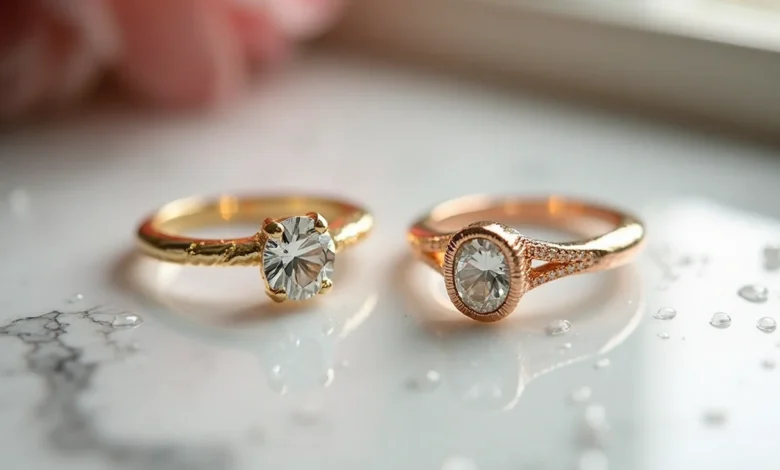
The plain gold band held its position for decades not because brides loved it, but because no one questioned it. That has changed. Brides shopping for wedding rings today are arriving with references saved, specific finishes in mind, and a clear sense that the band sitting next to their engagement ring should feel chosen, not defaulted to.
The shift is not uniform across all buyers. Brides with solitaire engagement rings on clean platinum settings are the ones most likely to go contemporary with the band, because a shaped or micro-set band sits flush against a solitaire in a way a plain round-profile band simply does not. Brides with halo or cluster engagement rings sometimes go the other direction, keeping the band minimal so the engagement ring stays the focal point.
The Shift Away From Traditional Bands
A plain court band does one thing well: it disappears, which for a long time was what brides wanted. What has changed is that more brides now want the wedding band to carry some of its own weight too, which is a different design brief entirely.
Shaped bands address a practical problem that shows up before anything else: a standard round-profile band pressed against a cathedral-set or raised-center engagement ring leaves a visible gap at the sides. A contoured band closes that gap by curving to follow the engagement ring’s profile.
Milgrain edges and micro-set diamond bands added a second layer to the shift. Both options add detail without competing with the engagement ring’s center stone, which is the exact balance most brides are trying to find.
What Makes a Wedding Ring Truly Contemporary in Design
Brushed and satin finishes changed what “platinum” means visually. A brushed or satin finish changes how platinum reads on the hand — the high-polish version pulls formal, while the brushed version sits closer to how contemporary jewelry tends to present itself: quieter, less ceremonial. The two look different sitting on the hand, not just in product photography.
Two-tone construction, where rose gold sits alongside white gold or platinum in the same band, gives the ring a depth that single-metal bands do not have. It also solves a specific problem for brides whose engagement ring is yellow or rose gold but who want platinum’s durability in the band; a two-tone band can bridge both metals without the visual disconnect of wearing completely mismatched colors.
Setting style is where contemporary and traditional diverge, and within contemporary options, roman-set and micro-set come down to stone size and spacing. Roman-set spaces diamonds at intervals across the surface, keeping the band smooth to the touch with light catching at distinct points. With micro-set, the stones are packed tight enough that the sparkle runs unbroken across the band rather than appearing as separate flashes, and both sit significantly lower against the finger than anything claw-set.
How to Choose the Right Women’s Wedding Ring That Reflects Your Style
The decision between a shaped and a straight band is not a style preference, it is a fit question first. If your engagement ring has a raised setting or a pronounced profile at the sides, a straight band will rock slightly on the finger rather than sitting flush. A shaped band eliminates that because it is cut to follow the exact curve of your engagement ring’s base.
Width is where personal style enters. At 2mm, a band reads as a fine accent, almost a line of metal beside the engagement ring. At 4mm or 5mm, it becomes a visible piece in its own right and shifts the overall look of the bridal set toward something bolder. The right width depends on your hand size as much as your preference: a 5mm band on a narrow finger can overpower the engagement ring visually, while a 2mm band on a wider hand can look unexpectedly slight.
When browsing women’s wedding rings, it is worth bringing your engagement ring or at minimum a photograph of it.
Why Hatton Garden Remains the Best Place to Find Contemporary Bridal Rings
A mass-produced contemporary band and a handcrafted one can look nearly identical in a photograph. The difference shows up in the finishing: the consistency of the milgrain beading around the edge, the evenness of micro-set stones across the band, the way the metal meets itself at the join. These are details a production line manages to a tolerance, where a bench jeweler manages them by eye.
Rennie & Co has been making rings in Hatton Garden since 1958, and the bespoke process there is not a premium add-on. If the width in their collection does not match what sits correctly against your engagement ring, or if you want a finish that is not in the standard range, those adjustments are part of the conversation rather than exceptions to a fixed catalog. That matters specifically for contemporary designs, where the fit against an existing ring is often the determining factor in whether the band works at all.