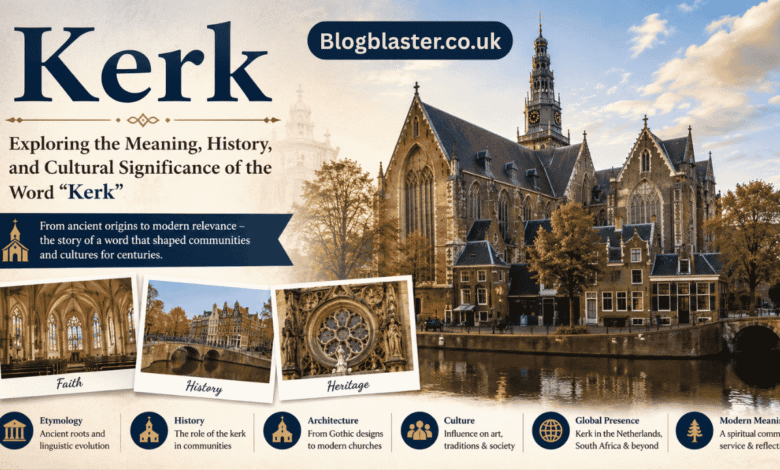
The word kerk may appear simple at first glance, but it carries centuries of history, culture, and religious significance. Primarily used in Dutch and Afrikaans, kerk translates to “church” in English. Beyond its literal meaning, the term represents faith, community, architectural heritage, and linguistic evolution across Europe and beyond.
As globalization encourages people to explore different cultures and languages, interest in words like kerk continues to grow. Whether you’re researching its linguistic roots, seeking information about famous Dutch churches, investigating the surname Kerk, or simply curious about the keyword itself, understanding its background offers fascinating insights into religion, history, and society.
This comprehensive guide explores everything you need to know about kerk, including its meaning, origins, historical development, architectural importance, modern relevance, and why it remains an important term today.
What Does Kerk Mean?
The term kerk is the Dutch and Afrikaans word for church.
In its most common usage, kerk refers to:
- A building where Christians gather for worship.
- A religious institution or denomination.
- A community of believers united by faith.
- The organized body of Christian followers.
For millions of Dutch and Afrikaans speakers, the word forms part of everyday language and religious identity.
Examples include:
- “Wij gaan naar de kerk.” – We are going to church.
- “Die kerk hou ‘n diens.” – The church is holding a service.
Although the translation is straightforward, the concept behind the word extends far beyond a physical structure.
The Etymology of Kerk
Understanding the history of kerk reveals how language evolves over time.
Ancient Greek Origins
The origins of kerk can be traced back to the Greek word:
Kyriakon (κυριακόν)
Meaning:
“The Lord’s house.”
This term referred to places dedicated to Christian worship.
Proto-Germanic Development
As Christianity spread through Europe, the word evolved into Proto-Germanic forms, eventually becoming:
- Old English: Cirice
- Old High German: Kirihha
- Old Dutch: Kirica
Middle Dutch Evolution
Over centuries, pronunciation and spelling have changed:
- Kirica
- Kerke
- Kerk
Eventually, modern Dutch and Afrikaans adopted the simplified form used today.
Kerk in Different Languages
One fascinating aspect of the keyword kerk is how similar words appear across Germanic languages.
| Dutch | Kerk | Church |
| Afrikaans | Kerk | Church |
| German | Kirche | Church |
| Danish | Kirke | Church |
| Norwegian | Kirke | Church |
| Swedish | Kyrka | Church |
| Scots | Kirk | Church |
| Icelandic | Kirkja | Church |
These similarities demonstrate shared linguistic ancestry dating back many centuries.
The Historical Role of the Kerk
Historically, the kerk served purposes far beyond worship.
Religious Center
Churches functioned as places where communities gathered to:
- Attend services.
- Celebrate holidays.
- Observe sacraments.
- Seek spiritual guidance.
Educational Institution
Before public education systems developed, many churches provided:
- Reading instruction.
- Religious education.
- Preservation of manuscripts.
- Academic training.
Community Hub
The kerk often acted as the heart of village life by hosting:
- Weddings.
- Funerals.
- Community meetings.
- Charitable activities.
Social Support Network
Churches offered assistance to vulnerable populations through:
- Food distribution.
- Shelter.
- Financial aid.
- Care for the elderly.
The impact of the kerk on European society cannot be overstated.
Famous Kerk Buildings Around the World
Several churches bearing the word kerk have become internationally recognized landmarks.
Oude Kerk (Old Church)
Located in Amsterdam, the Oude Kerk is the city’s oldest surviving building.
Highlights include:
- Founded around 1213.
- Gothic architecture.
- Historical significance.
- Contemporary art exhibitions.
Today, it remains both a functioning church and a cultural venue.
Nieuwe Kerk (New Church)
Also situated in Amsterdam, the Nieuwe Kerk has played a major role in Dutch history.
Notable features include:
- Royal inauguration ceremonies.
- National exhibitions.
- Historical artifacts.
- Architectural beauty.
The church attracts thousands of visitors annually.
Grote Kerk
Meaning “Great Church,” numerous Dutch cities have their own Grote Kerk.
Examples include:
- Haarlem.
- Breda.
- The Hague.
- Dordrecht.
These churches showcase remarkable examples of medieval craftsmanship.
Kerk and Dutch Culture
In the Netherlands, the concept of kerk runs deep in cultural identity.
Influence on Daily Life
Historically, church schedules shaped daily routines.
Communities organized life around:
- Sunday services.
- Religious festivals.
- Seasonal celebrations.
Artistic Contributions
Dutch churches inspired generations of artists.
Painters frequently depicted:
- Church interiors.
- Congregational life.
- Religious symbolism.
- Architectural details.
National Heritage
Many historic kerk buildings are preserved as national monuments.
They attract visitors interested in:
- Tourism.
- Architecture.
- Religious history.
- Cultural exploration.
The Kerk in South Africa
Afrikaans speakers also use the term kerk extensively.
South African churches played significant roles in:
Community Formation
Churches helped establish:
- Settlements.
- Schools.
- Charitable organizations.
Cultural Preservation
The kerk became important in maintaining:
- Afrikaans language traditions.
- Community identity.
- Religious practices.
Social Debate
Throughout South African history, churches have influenced discussions concerning:
- Justice.
- Equality.
- Reconciliation.
- National development.
Their impact continues in modern society.
Kerk as a Surname
Another intriguing aspect of this keyword is its use as a family name.
Origins of the Surname
The surname Kerk likely developed through:
Geographic Association
Individuals living near churches often adopted related names.
Occupational Connections
Some ancestors may have worked for religious institutions.
Cultural Adaptation
Migration caused variations in spelling and pronunciation.
Regions Associated with the Surname
The surname appears among families with roots in:
- The Netherlands.
- Germany.
- England.
- Malaysia.
- Chinese communities.
Genealogists continue researching their various lineages.
Notable Individuals Named Kerk
Several public figures carry the surname.
Gyrano Kerk
A professional Dutch footballer known for:
- Speed.
- Versatility.
- Goal-scoring ability.
- International competition.
Sebastian Kerk
German football player recognized for:
- Midfield creativity.
- Technical skills.
- Professional club experience.
Kerk Chee Yee
Malaysian politician involved in public service and governance.
These individuals have helped increase the visibility of the surname globally.
Architecture and Design of the Kerk
Church architecture reflects changing artistic movements and theological priorities.
Gothic Architecture
Common features include:
- Pointed arches.
- Ribbed vaults.
- Large stained-glass windows.
- Towering spires.
Romanesque Style
Characteristics include:
- Rounded arches.
- Thick walls.
- Massive pillars.
- Decorative carvings.
Modern Church Design
Contemporary kerk structures often emphasize:
- Simplicity.
- Functionality.
- Community spaces.
- Environmental sustainability.
Architectural evolution demonstrates the adaptability of religious institutions.
The Modern Meaning of Kerk
Today, the concept of kerk extends beyond traditional worship spaces.
Many people interpret the church as:
A Spiritual Community
Faith expressed through relationships rather than buildings.
A Place of Service
Organizations focused on helping others.
Cultural Heritage
Historic sites preserving collective memory.
Personal Reflection
Spaces promoting peace, meditation, and contemplation.
This broader understanding reflects changing societal attitudes toward religion.
Why Are People Searching for “Kerk”?
Interest in the keyword kerk has grown for several reasons.
Language Learning
People studying Dutch or Afrikaans often encounter the term early in their lessons.
Travel Research
Tourists seek information about famous Dutch churches.
Genealogy
Researchers investigate the Kerk surname.
Religious Curiosity
Individuals explore Christian traditions and terminology.
Academic Study
Students examine church history, architecture, and cultural influence.
The keyword satisfies diverse informational needs.
SEO Importance of the Keyword Kerk
From an SEO perspective, Kerk offers opportunities across several niches.
Potential content categories include:
- Religion.
- Travel.
- Dutch culture.
- Genealogy.
- Language learning.
- Architecture.
- History.
Targeting long-tail variations can attract highly engaged readers.
Examples include:
- What does kerk mean?
- Famous kerk buildings in Amsterdam.
- Kerk surname origin.
- Dutch kerk history.
- Afrikaanse kerktradisies.
Conclusion
The word kerk represents far more than its simple English translation of “church.” Rooted in ancient Greek and shaped by centuries of linguistic evolution, it has become a symbol of faith, culture, architecture, and community across Dutch and Afrikaans-speaking societies.
You May Also Read: HopTraveler.com Luxury Travel: Premium Travel Experiences Around the World