Outdoor Christmas lights fail for predictable reasons. They were never rated for outdoor use in the first place. They were connected through an indoor extension lead. They were packed away wet last January. Or they were hung in a way that put strain on the cable all season until something gave.
None of this is difficult to avoid. Here is the whole job, done properly.
Start with the Right Product
The first and most important check is whether the lights are actually designed to go outside. Indoor sets are not weather-sealed, and a British December will find every gap.
Look for an IP rating on the packaging. IP44 is the usual minimum for outdoor use and is adequate for sheltered positions such as a porch or under an eave. IP65 or above is appropriate for fully exposed runs on a roofline, in a tree or anywhere that will sit in driving rain.
Also check the transformer or power supply, because on many low-voltage sets the lights themselves are rated for outdoors but the transformer is not. If that is the case, the transformer has to live indoors or in a properly weatherproof enclosure.
Work Out the Power Situation First
Before anything goes up, establish where the electricity is coming from and what it is going through.
Outdoor lighting should be connected through an RCD, either a permanently installed outdoor socket with RCD protection or a plug-in RCD adaptor. This is the single most important safety measure in the whole job and it costs very little.
Extension leads used outdoors must be outdoor-rated, with sealed connections. An ordinary indoor extension lead does not become suitable because one end is inside. Keep every connection off the ground, out of puddles and clear of leaf litter, and never run a cable under a door that will then be closed on it.
Add up what you are plugging in and keep well within the rating of the socket and the lead. Modern LED sets draw very little, which makes this easier than it used to be, but the limit is still a limit.
Test Everything Before It Goes Up
Lay every set out on the ground and plug it in. Finding a dead section after you have threaded it through a hedge is one of the small, avoidable miseries of December.
While they are out, inspect them properly. Look for cracked or hardened insulation, exposed copper near the plug, scorch marks, loose bulb holders and corrosion on contacts. Anything damaged gets replaced rather than repaired, and taped-up cable is not a repair. Electrical Safety First’s guidance on Christmas lighting sets out clearly what is worth keeping and what should go in the bin.
Plan the Run Before You Climb Anything
Sketch it. It sounds excessive and it saves an enormous amount of time.
Measure the lengths you need, work out where each set starts and ends, and establish where the joins will fall. The aim is for every connection to land somewhere sheltered and reachable rather than halfway along a gutter at roof height.
Then count your sets against your measurements rather than hoping. Running out two metres from the end, in the dark, in December, is the usual outcome of not doing this.
Fixings That Will Not Damage the House
Never staple, nail or screw through a cable. It is the most common cause of serious faults in seasonal lighting and the damage is often invisible until something trips.
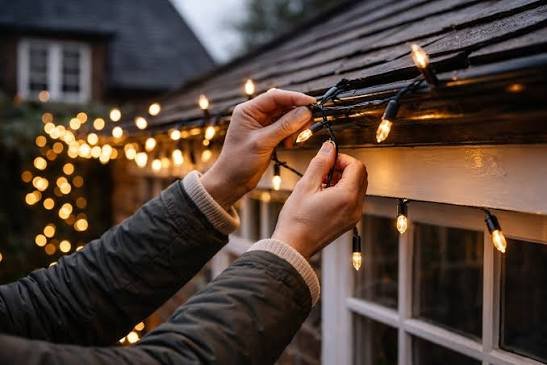
Use purpose-made clips. Gutter clips hook over the lip without any fixing at all. Brick clips grip mortar joints. Shingle and tile clips slide under roof edges. All are cheap, all are removable, and none of them put a hole in anything.
Leave a little slack in the run. A cable pulled tight contracts further in cold weather and puts constant strain on the connections at either end.
Working at Height
Most seasonal injuries are falls, not shocks, and the circumstances are consistent: working alone, overreaching from a ladder, or working in wet or windy conditions.
Have someone foot the ladder. Move the ladder rather than stretching sideways. Keep three points of contact. Do not do it in the rain, in strong wind or in fading light, and do not do it at all if there is a sensible way to achieve the same effect at ground level. RoSPA publishes seasonal safety advice covering exactly this, and it takes a couple of minutes to read.
Choosing What to Buy
Beyond the IP rating, the decisions that matter are colour temperature, bulb spacing and whether you want static or animated settings.
Warm white is the most forgiving outdoors and flatters brick, render and stone. Cool white and ice white look crisp and modern but can read as stark against a warm-toned house. Mixing the two across one frontage is the most common aesthetic mistake people make.
Bulb spacing determines density: closely spaced bulbs read as a continuous line of light, widely spaced ones as individual points. Both work, but they look very different on a roofline. It is worth comparing outdoor Christmas lights in different lengths, spacings and colour temperatures before committing, since a set that looks right in a product photograph can be considerably sparser in reality.
Mains or Low Voltage?
Outdoor sets come in two broad types and the difference affects how you install them.
Mains-voltage sets plug straight into a socket and are generally the cheaper option, but every connection has to be treated seriously and the whole run must be properly rated and RCD-protected.
Low-voltage sets run through a transformer that steps the supply down, usually to 24V or 31V. The lighting side is considerably safer to handle, which is a genuine advantage in a garden used by children or pets. The catch, as above, is that the transformer itself is frequently rated for indoor use only and must be housed accordingly.
Battery sets have improved enormously and are worth considering for anywhere without a nearby socket, particularly for wreaths, small trees and window displays. Choose sets with a timer function built in, since changing batteries in January is nobody’s idea of a good evening.
Put It on a Timer
A plug-in timer or an outdoor-rated smart plug costs very little and solves several things at once. It stops anyone having to go outside in the cold to switch things off, it keeps the running cost predictable, and it means nothing is left blazing overnight, which is both the safety advice and the neighbourly thing to do.
Four in the afternoon until eleven at night is the usual window and covers most of the people who will actually see it.
Taking Them Down and Keeping Them
This is where next year’s problems are created.
Choose a dry day. Let everything dry fully indoors before it goes anywhere near a box, because packing damp lights is what produces corroded contacts and dead sections next November. Coil cables loosely around a piece of stiff card rather than winding them into a ball, which stresses the wire at every bend.
Label each set with its length and where it was used. Next December starts with working lights and a plan rather than with a tangle and a guess, which is a considerably better position to be in.