There’s a persistent idea that Land Rovers are simply unreliable, full stop. The picture is more nuanced. In the latest What Car? Reliability Survey linked in this article, published in 2025, Land Rover placed 27th out of 31 brands, while the 2020-present Defender scored 96.3%. The same survey reported faults across areas such as the engine, infotainment, bodywork, steering and electrics depending on model. That mix is one reason a scanner with broad system access can be useful on JLR vehicles.
Why JLR Vehicles Ask More of a Diagnostic Tool
JLR vehicles can use many electronic control modules across systems such as air suspension, adaptive damping, driver assistance, body control, ABS, airbags and HVAC. A basic generic OBD2 reader may only provide limited access, while deeper diagnosis can require manufacturer-specific system coverage.
For example, reading an air-suspension fault code is not the same as being able to run a supported ride-height calibration after a repair. Service functions also vary by model and year, so a scanner needs to match the exact vehicle rather than simply list Land Rover or Jaguar on the box.
JLR models use multiple control modules that exchange data across vehicle networks. A fault shown in one system can sometimes be related to a sensor, wiring issue or another module, so diagnosis benefits from full-system scanning, live data and, where supported, active tests rather than code reading alone.
The Faults That Come Up Again and Again
Several fault areas recur across JLR ownership reports and workshop discussions, although frequency varies by model, engine, year and mileage.
On the Land Rover Side
- Air-suspension compressor, valve-block, air-spring and height-sensor faults on air-suspension-equipped Range Rover, Range Rover Sport and Discovery models
- Timing-chain or related engine-mechanical faults on certain engines, where diagnosis should be based on symptoms, live data and inspection rather than a simple code-and-clear
- EGR and DPF-related faults on diesel variants doing a lot of short journeys
- Electrical faults traced to body control modules affecting central locking, window regulators, or dashboard warning lights that don’t match the actual problem
On the Jaguar Side
- Suspension or adaptive-damping faults on equipped Jaguar models, with functions and failure patterns varying by model and year
- Electrical or infotainment faults that may involve multiple modules and require full-system diagnosis
- Fault codes on the I-Pace require extra care because its high-voltage electric drivetrain adds safety and system-specific diagnostic considerations alongside body and chassis modules
Why a Wrong Diagnosis Costs More on These Cars Than Most
Misdiagnosis can be expensive on any vehicle, and premium JLR parts and labour can make unnecessary replacement especially costly. An air-suspension warning, for example, may involve the compressor, valve block, air spring, height sensor, wiring or another related component. A scanner with deeper system access can help narrow the fault before parts are replaced.
A warning shown by one system can also be triggered by a communication or sensor issue elsewhere. Full-system diagnostics, live data and supported active tests can reduce guesswork and help a technician confirm the likely cause before committing to repairs.
Choosing a Tool That Actually Handles These Systems
A capable JLR scanner should go beyond reading and clearing codes and, where supported, provide functions such as air-suspension calibration, bi-directional or active tests, steering-angle sensor reset and DPF regeneration. Exact support varies by model, year and ECU configuration, so compatibility should be confirmed before purchase. The iCarsoft LR V4.0, for instance, lists air-suspension service, SAS reset, DPF regeneration and full bi-directional control for supported Jaguar and Land Rover vehicles.
It is also worth checking coverage against your specific model, year, engine and ECU configuration rather than assuming “Land Rover” or “Jaguar” support covers every function equally. Confirming compatibility before buying is especially important for newer or lower-volume variants and for advanced service functions.
Live data can be as useful as stored fault codes. Watching ride-height values, sensor readings or other parameters while a system operates can help distinguish intermittent or dynamic faults that may not be obvious from a stored code alone.
Jaguar Isn’t Just “Land Rover With a Different Badge”
It’s a common assumption, understandable given the shared ownership, but the two brands don’t run identical systems underneath. Some platforms and components are genuinely shared, the F-Pace and Velar sit on closely related underpinnings, for instance, but Jaguar’s own software, model-specific service functions, and electrical architecture differ enough that a tool needs proper coverage of both marques individually rather than treating one as a stand-in for the other. A scanner that’s excellent on Land Rovers can still fall short on a Jaguar it technically “supports” if that support wasn’t built out with the same depth.
This matters more for mixed-fleet independents than it does for a one-car household, simply because the mistake is easier to make at scale. A garage that’s built genuine expertise on Discoverys and Range Rovers can reasonably assume their tool handles an XF or F-Pace just as well, right up until a Jaguar-specific service function turns out to be missing or only partially supported. Checking both brands separately against your actual workload, rather than assuming coverage of one implies the other, avoids finding this out mid-job.
What This Looks Like in Practice
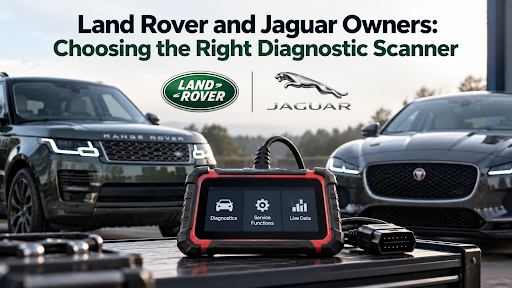
For owners and independent garages dealing with both brands regularly, an iCarsoft Land Rover Jaguar scanner is designed specifically around Jaguar and Land Rover coverage. On supported vehicles, models such as the LR V4.0 include air-suspension service, SAS reset, DPF regeneration and bi-directional control. Albionshire also stocks a wider range of iCarsoft scanners for buyers comparing a JLR-focused tool with a multi-brand option. Always check the manufacturer’s function list or confirm compatibility for the exact vehicle before relying on a feature.
Whichever tool you choose, the key question is whether it supports the diagnostic and service functions you actually need, not simply whether it can read a fault code. On JLR vehicles, full-system access, live data and supported service functions can reduce unnecessary parts replacement and make troubleshooting more efficient.
The reliability picture varies significantly by model and year, and newer models such as the Defender have scored strongly in recent surveys. The practical point is to use a scanner whose documented coverage matches the vehicle and the task rather than relying on compatibility claims alone.