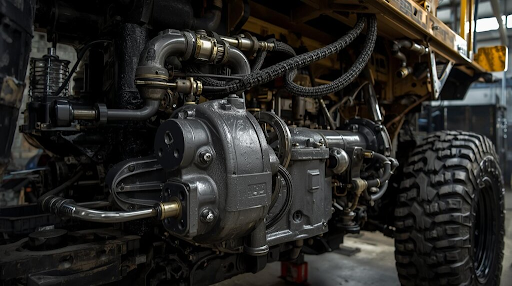
If you want to choose a reliable and high-quality hydraulic pump for your machine, you’ve come to the right place. This guide aims to introduce the 3 main hydraulic pumps and their roles, key advantages, limitations, and more, helping you find the perfect fit. Follow and learn the necessary information right now!
Type 1: Gear Pumps
How It Works
Gear pumps move hydraulic fluid by using two meshing gears to push oil from the inlet to the outlet, delivering a fixed flow per rotation—ideal for simple, open‑center systems.
Key Advantages
- Durable and Simple: Fewer moving parts, easy to service.
- Cost-Effective: Lowest initial and replacement cost.
- Contamination-Tolerant: Looser tolerances make them more forgiving to minor fluid contamination.
Limitations
- Lower Efficiency: Internal leakage increases with wear.
- No Variable Flow: Flow rate fixed to pump speed.
- Noisy: Gear meshing produces audible vibration during operation.
Common Uses
- Power steering and lube systems
- Charge pumps for hydrostatic transmissions
- Auxiliary hydraulic functions on smaller dozers, loaders, and farm equipment
Type 2: Vane Pumps
How It Works
A vane pump has a rotor mounted off-center inside a cam ring. As the rotor spins, vanes slide in and out, forming expanding chambers on the inlet side and contracting chambers on the outlet side.
This design produces steady, low-pulsation flow — ideal for control-sensitive or noise-restricted applications.
Key Advantages
- Low Noise & Vibration: Quieter than gear pumps.
- Good Efficiency: Balanced flow for stable machine operation.
- Variable Displacement Versions: Some models can adjust flow to match load requirements.
Limitations
- Less Contamination Tolerant: Vanes require clean oil and tight filtration.
- Moderate Pressure Rating: Not built for extreme pressure systems.
Common Uses
- Utility vehicles and equipment prioritizing quiet operation
- Mid-pressure hydraulic circuits
- Control functions where flow stability matters
Type 3: Piston Pumps
How It Works
Piston pumps use multiple pistons reciprocating in a cylinder block.
In axial-piston pumps, a tilted swashplate determines piston stroke — adjusting flow from zero to full capacity (variable displacement).
Key Advantages
- Highest Pressure & Efficiency: Operates at 4,000+ PSI with minimal internal leakage.
- Variable Control: Swashplate angle changes with system pressure for load-sensing capability.
- Smooth Performance: Precise flow modulation suitable for modern excavators or dozers.
Limitations
- Highest Cost: Complex design and precision components.
- Filtration Critical: Very sensitive to debris contamination.
- Complex Repair: Requires specialized tools and rebuild expertise.
Key Variants
- Fixed Displacement: Delivers a constant flow at a given speed, typically used in open-center systems or circuits with fixed demands.
- Variable Displacement: Can adjust its output flow. Common control methods include:
- Pressure-Compensated: The pump automatically reduces its flow (strokes) when the system pressure reaches a preset maximum. This prevents system overload and saves energy by only producing the pressure required.
- Load-Sensing: The pump adjusts its output flow and pressure to precisely match the immediate demand of the load. A signal line from the working circuit tells the pump exactly how much flow and pressure are needed. This is the most energy-efficient control method and includes a pressure compensator to limit maximum system pressure.
- Pressure-Compensated: The pump automatically reduces its flow (strokes) when the system pressure reaches a preset maximum. This prevents system overload and saves energy by only producing the pressure required.
Common Uses
- Excavator main hydraulic circuits
- High-force lifting and earthmoving
- Hydrostatic transmissions and precision control systems
Pro Tip: Always pair piston pumps with clean hydraulic oil and proper filters. Using compatible hydraulic pumps helps maintain OEM-level performance.
Hydraulic Pump Types Comparison
| Pump Type | Pressure Capability | Efficiency | Noise | Contamination Tolerance | Cost | Common Use |
| Gear Pump | Low–Medium | Moderate | High | High | Low | Auxiliary & lighter systems |
| Vane Pump | Medium | Good | Low | Moderate | Medium | Utility & mid-pressure systems |
| Piston Pump | High | Excellent | Moderate | Low | High | Excavators, dozers, high-load systems |
Other Specialized Hydraulic Pumps
While gear, vane, and piston pumps dominate general heavy-equipment use, certain vehicles use specialized pumps:
- Clutch Pumps: Small gear pump driven by belt with electromagnetic clutch — used on aerial trucks, wreckers, light hydraulic systems (<15 GPM).
- Dump Pumps: Integrated valve and relief assembly for dump trucks; built for short, high-flow operations.
- Dry Valve & Live Pak Pumps: Used in refuse trucks — minimize energy consumption when hydraulic flow isn’t needed.
These specialized types are less common in modern machines but illustrate how hydraulic power adapts to different vehicle systems.
Final Words
Choosing the right hydraulic pump impacts performance, efficiency, and reliability. You should know how each type works and ensure you make informed, cost-effective replacement decisions using proven hydraulic pumps.
Keep your hydraulic fluid clean, match the right pump to your system’s pressure demand, and your equipment will deliver consistent power and productivity for years.