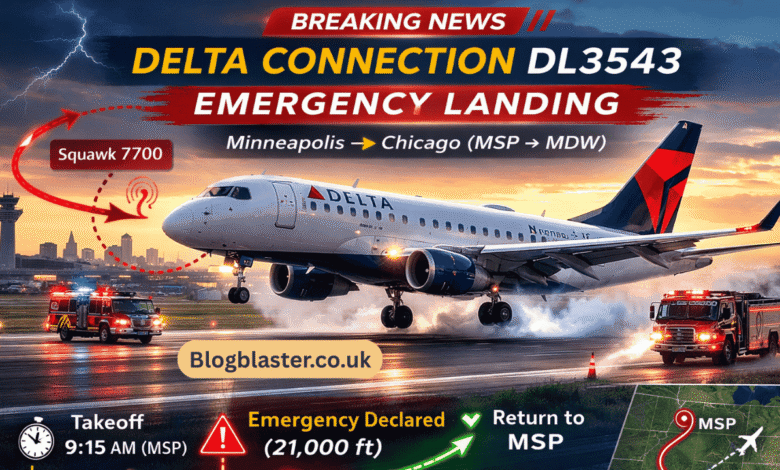
Air travel remains one of the safest modes of transportation, but when news breaks that an aircraft has declared an emergency, passengers understandably want answers. The Delta Connection DL3543 emergency landing is one such event that quickly drew attention among aviation watchers and travellers alike. In this comprehensive report, we break down everything currently known about the Delta Connection flight DL3543 emergency landing, including the flight route, aircraft type, timeline of events, what an emergency declaration means, and how situations like this are typically handled in commercial aviation.
Overview of the Delta Connection DL3543 Emergency Landing
On July 7, 2025, Delta Connection flight DL3543 declared an in-flight emergency shortly after departing from Minneapolis–Saint Paul International Airport (MSP). The aircraft was scheduled to fly to Chicago Midway International Airport (MDW).
Shortly after takeoff, the crew stopped their climb, turned the aircraft around, and returned safely to MSP. The flight reportedly squawked 7700, the universal transponder code for an emergency.
The aircraft landed safely back at its departure airport, and no injuries were publicly reported.
Flight Details: Delta Connection DL3543
Here are the key details related to the incident:
- Flight Number: DL3543
- Operator: Delta Connection (regional partner operation)
- Route: Minneapolis–Saint Paul (MSP) to Chicago Midway (MDW)
- Aircraft Type: Embraer ERJ 170-200 LR (commonly referred to as the E175LR)
- Aircraft Registration: N259SY
- Date of Incident: July 7, 2025
- Emergency Code Used: Squawk 7700
- Return Airport: Minneapolis–Saint Paul International Airport
- Landing Outcome: Safe landing, no confirmed injuries
The aircraft involved, an Embraer E175LR, is a widely used regional jet known for reliability and passenger comfort in short- to mid-range routes.
Timeline of the Delta Connection DL3543 Emergency
Understanding the timeline helps clarify what happened during the Delta Connection DL3543 emergency landing:
Departure from MSP
Flight DL3543 departed Minneapolis–Saint Paul International Airport as scheduled. Weather conditions at the time were not reported as extreme or hazardous.
Climb to Approximately 21,000 Feet
After takeoff, the aircraft climbed to roughly 21,000 feet. At this point, something prompted the flight crew to discontinue the climb.
Emergency Declaration (Squawk 7700)
The flight crew transmitted squawk 7700, indicating to air traffic control that the aircraft was experiencing an emergency. This does not automatically mean a catastrophic failure—it simply means the crew requires priority handling.
Turnback to MSP
Approximately 10 minutes after departure, the aircraft turned back toward Minneapolis–Saint Paul. Air traffic control would have provided priority routing and coordination with airport emergency services.
Safe Landing
The aircraft landed safely on Runway 12R at MSP approximately 37 minutes after departure. The plane reportedly taxied to a gate or stand without further incident.
What Does Squawk 7700 Mean?
A key part of the Delta Connection DL3543 emergency landing was the use of transponder code 7700.
In aviation, squawk codes are four-digit numbers transmitted by an aircraft’s transponder to communicate specific conditions to air traffic control.
- 7700 = General emergency
- 7600 = Radio communication failure
- 7500 = Unlawful interference (hijacking)
When pilots squawk 7700, they are requesting immediate priority handling. This can be triggered by a range of issues, including:
- Mechanical irregularities
- Pressurization warnings
- Engine performance concerns
- Medical emergencies onboard
- System alerts requiring a precautionary landing
Importantly, declaring an emergency is a proactive safety measure. Pilots are trained to err on the side of caution.
Aircraft Information: Embraer E175LR (N259SY)
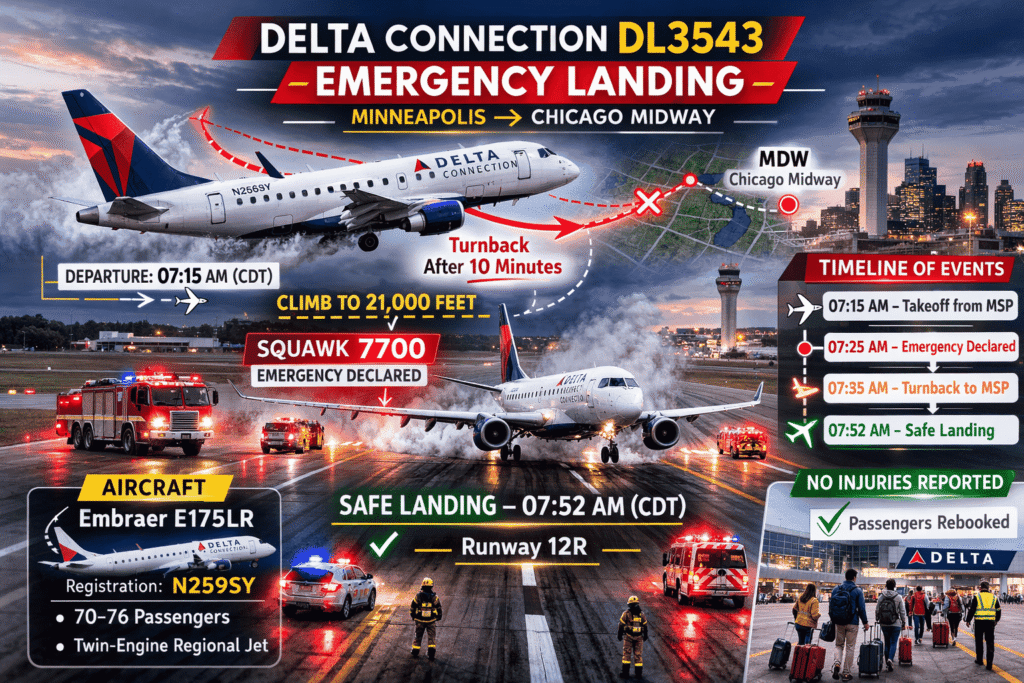
The aircraft involved in the Delta Connection DL3543 emergency landing was an Embraer ERJ 170-200 LR, better known as the E175LR.
About the E175LR
The Embraer E175 is widely used by regional carriers operating under major airline brands, including Delta Connection. Key features include:
- Seating capacity: Typically 70–76 passengers
- Twin-engine regional jet
- Advanced avionics systems
- Designed for short to medium-haul routes
- Strong safety record
The specific aircraft, registered as N259SY, was listed as having a valid FAA registration at the time of the incident.
The E175 is considered one of the most reliable regional jets in operation today.
Possible Causes of the Emergency
As of the information publicly available, no official statement confirmed the exact cause of the Delta Connection DL3543 emergency landing.
In similar situations, emergency returns are often precautionary and may involve:
- Minor mechanical anomalies
- Sensor or warning system alerts
- Cabin pressure indications
- Unusual instrument readings
- Passenger medical emergencies
It is important to note that many emergency declarations result from caution rather than confirmed system failure. Modern aircraft are equipped with highly sensitive detection systems designed to alert crews early.
How Airlines Handle Emergency Landings
When a flight like DL3543 declares an emergency, a coordinated process begins immediately:
Air Traffic Control Priority
ATC clears the airspace and provides the most direct routing back to the airport.
Airport Emergency Services Alerted
Fire and rescue vehicles are positioned near the runway as a precaution.
Controlled Landing
Pilots follow standard emergency return checklists while preparing the aircraft for landing.
Post-Landing Inspection
After landing, maintenance crews inspect the aircraft to determine the cause of the issue.
Passengers are usually rebooked onto later flights once the situation stabilises.
Passenger Experience During the Incident
In most emergency return scenarios, like the Delta Connection DL3543 emergency landing, passengers may experience:
- A change in engine power settings
- A noticeable turn shortly after takeoff
- Announcements from the flight crew explaining a return
- Emergency vehicles are visible upon landing
While hearing the word “emergency” can be alarming, most emergency landings end safely and without injury.
Airlines train flight attendants to remain calm and keep passengers informed.
Are Emergency Landings Common?
Despite how dramatic headlines may sound, emergency declarations happen more often than people realise—and most end safely.
Key facts:
- Commercial aviation has multiple redundancy systems.
- Pilots undergo simulator training for emergency scenarios multiple times per year.
- Aircraft are designed to fly safely even with system failures.
- Most emergency landings are precautionary.
Statistically, commercial aviation remains extraordinarily safe.
Why Returning to the Departure Airport Is Common
In cases like DL3543, returning to the origin airport makes sense for several reasons:
- Known runway configuration
- Available maintenance teams
- Established airline operational base
- Better logistical support
Minneapolis–Saint Paul International Airport is a major Delta hub, making it an ideal return location for Delta Connection aircraft.
Impact on Flight Operations
An emergency return can temporarily disrupt airport operations, but these events are typically resolved quickly.
Potential impacts include:
- Minor delays for other departures
- Temporary runway closure
- Aircraft taken out of service for inspection
However, modern airports are designed to handle such events efficiently.
Delta Connection: What It Means
Some passengers may wonder what “Delta Connection” signifies.
Delta Connection is a brand name used by Delta Air Lines for regional flights operated by partner airlines. These carriers operate smaller aircraft, such as the Embraer E175, on behalf of Delta.
Passengers book through Delta, but the aircraft may be operated by a regional affiliate.
This operational structure does not affect safety standards. All flights operate under FAA regulations and Delta’s oversight.
Safety Record of the Embraer E175
The Embraer E175 has an excellent safety record and is widely respected in the aviation industry.
Key reasons for its strong reputation:
- Proven twin-engine reliability
- Advanced avionics systems
- Efficient design
- Continuous upgrades
- Strong global fleet performance
Events like the Delta Connection DL3543 emergency landing are rare relative to the number of daily E175 flights worldwide.
What Happens Next After an Emergency Landing?
Following incidents like DL3543:
- The aircraft undergoes inspection.
- Maintenance teams diagnose the issue.
- Reports may be filed with aviation authorities if required.
- The aircraft returns to service only after clearance.
In many cases, the issue is minor and resolved quickly.
Final Thoughts on the Delta Connection DL3543 Emergency Landing
The Delta Connection DL3543 emergency landing demonstrates how aviation safety systems function exactly as intended.
The crew identified a potential issue.
They declared an emergency.
They returned safely.
The aircraft landed without injury.
While emergency declarations understandably cause concern, they are part of a structured safety system designed to protect passengers and crew.
Commercial aviation continues to maintain one of the strongest safety records of any transportation industry worldwide.
Frequently Asked Questions (FAQ)
What happened on Delta Connection DL3543?
The flight declared an emergency shortly after departure from Minneapolis–Saint Paul and returned safely to the airport.
Was anyone injured?
There were no confirmed reports of injuries.
What does squawk 7700 mean?
It is the transponder code indicating a general emergency.
What aircraft was involved?
An Embraer ERJ 170-200 LR (E175LR), registration N259SY.
Is the Embraer E175 safe?
Yes, it has a strong safety record and is widely used by airlines globally.
You May Also Read: Flights Cancelled Spain: Causes, Passenger Rights, and How to Protect Your Trip