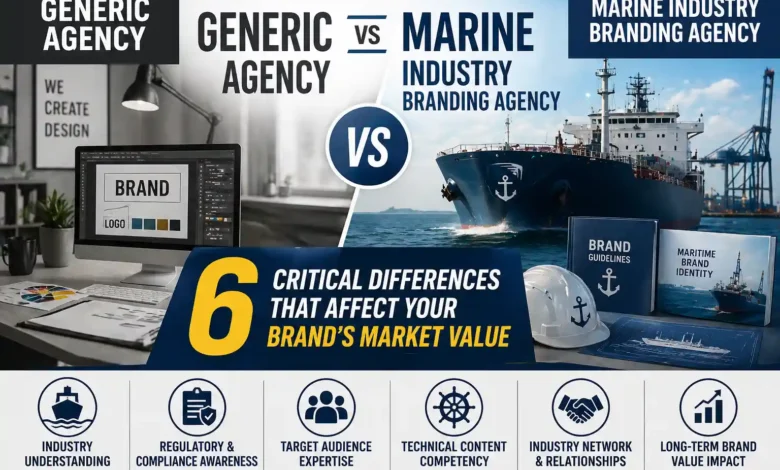
Generic Agency vs Marine Industry Branding Agency: 6 Critical Differences That Affect Your Brand’s Market Value

When a shipowner, port operator, or maritime equipment supplier decides to invest in brand identity work, the instinct is often to approach a well-reviewed general creative agency. The logic seems sound: experienced designers, polished portfolios, proven process. But the marine and offshore sector operates under conditions that most agencies have never encountered professionally, and the gap between a generic creative approach and one grounded in industry knowledge tends to surface in ways that are difficult and costly to correct later.
Brand identity in the marine sector is not simply about producing a logo, a colour palette, and a brand guideline document. It involves representing organisations that operate under international regulatory frameworks, serve highly technical procurement audiences, and often compete for contracts where credibility and consistency carry as much weight as commercial positioning. The difference between an agency that understands this environment and one that does not is not merely stylistic. It affects how your brand performs across tenders, fleet documentation, port communications, and long-term market recognition.
This article examines six specific differences between working with a generalist agency and a specialist one, and explains why those differences matter to decision-makers in maritime commerce and related industries.
1. Industry Familiarity Changes How Your Brand Is Built From the Ground Up
Brand identity design services delivered by a generalist agency typically begin with a discovery phase that asks broad questions about your audience, values, and competitive positioning. These are reasonable starting points for most industries. In the marine sector, however, the audience itself is far more segmented and technically oriented than in most commercial markets. A port authority, a classification society, a shipbuilder, and a maritime insurer all receive and evaluate brand communications differently. An agency without direct exposure to these relationships will struggle to account for that variation during the foundational brand-building stage.
A marine industry branding agency approaches the discovery process with a pre-existing understanding of how the sector is structured, how procurement and vendor evaluation typically work, and what visual and tonal standards carry professional credibility in maritime contexts. That prior knowledge shortens the time needed to establish accurate positioning and reduces the likelihood of building a brand identity on assumptions that do not hold in practice.
Why This Matters Beyond the Initial Brief
Brand identity decisions made during the early stages of a project have long-term consequences. The typography chosen, the visual language developed, and the tone of voice guidelines written all shape how the brand appears across years of use — on vessel documentation, tender submissions, safety signage, crew communications, and industry publications. If those foundational decisions were made by a team without sector knowledge, the brand may look polished in isolation but feel inconsistent or inappropriate when deployed across actual operational contexts. Correcting foundational brand work is significantly more resource-intensive than getting it right in the first instance.
2. Technical Vocabulary and Regulatory Context Cannot Be Improvised
Marine industry communications regularly involve references to international standards, flag state requirements, classification rules, and safety conventions. The International Maritime Organization maintains the global regulatory framework within which most maritime operators work, and that framework shapes everything from how vessels are documented to how safety information must be communicated visually. A generic agency working on brand identity design services for a maritime client will rarely have fluency in this environment, and the absence of that fluency introduces errors in language, tone, and context that erode credibility with technical audiences.
The Credibility Cost of Getting the Language Wrong
In industries where procurement decisions are made by engineers, fleet managers, and compliance officers, brand communications that misuse technical terminology or reference regulatory structures incorrectly signal a lack of operational seriousness. This may seem like a small concern, but in the marine sector, where contract values are substantial and relationships are built on demonstrated competence, even minor inconsistencies in how a brand presents itself can affect how potential clients evaluate your organisation. A branding team that already understands port operations, vessel classification, and maritime logistics does not need to be corrected by the client during every review cycle.
3. Visual Standards in the Marine Sector Reflect Functional Requirements
Marine brand identity is applied across a range of surfaces and formats that differ significantly from those found in retail, hospitality, or technology sectors. Vessel hull markings, safety placards, officer uniforms, port facility signage, and offshore equipment labels all have practical constraints related to visibility, durability, and regulatory compliance. A generalist creative team approaching brand identity design services for a marine client may not think to account for these applications during the visual identity development phase.
When Aesthetics Conflict With Operational Reality
A brand identity that looks refined in a digital presentation but performs poorly on weathered steel or under low-visibility conditions at sea is not a fully functional brand identity. Colour choices that work beautifully on screen may fail under the lighting conditions common to engine rooms, cargo holds, or outdoor port environments. An agency with marine sector experience will consider these requirements as part of the design brief rather than as afterthoughts raised during implementation. This reduces the need for costly revisions once the brand identity begins to be applied across real operational assets.
4. Audience Segmentation in Maritime Markets Requires Sector-Specific Insight
The marine and offshore industry serves a wide range of distinct audiences that a generalist agency is unlikely to be able to differentiate meaningfully without substantial research. Shipowners, charterers, port authorities, flag state administrators, classification societies, cargo owners, and marine insurers all have different decision-making priorities. Effective brand identity design services in this sector require an understanding of how these audiences differ, not just in demographic terms, but in the professional values and evaluation criteria they apply when assessing suppliers and partners.
What Generic Segmentation Misses
A general agency may segment the marine market into categories like B2B and B2C, or large enterprise and SME. These categories are not wrong, but they are too broad to inform meaningful brand positioning in a sector where trust, safety track record, and technical capability are primary purchasing drivers. The brand voice, visual positioning, and communication style that resonate with a ship management company differ from those that work for a maritime law firm or a bunker fuel supplier. A specialist agency brings this understanding to the work before the first workshop is held, rather than attempting to learn it during the engagement.
5. Brand Consistency Across Global Operations Requires Planning That Generalists Often Overlook
Maritime organisations frequently operate across multiple jurisdictions, with vessels flagged in different states, offices in multiple port cities, and crew drawn from many nationalities. Brand identity design services for this type of organisation must account for how the brand will be applied and maintained across a geographically dispersed operation with varying levels of in-house design capability. A generic agency will often deliver a brand guidelines document and consider the project complete. A marine sector specialist is more likely to build scalability into the identity system from the start.
Consistency as a Risk Management Concern
Brand inconsistency in the marine industry is not merely an aesthetic problem. When a vessel’s markings, its operator’s documentation, and its digital presence all present the brand differently, it creates confusion during audits, port state control inspections, and insurance assessments. Maintaining a consistent brand presence across global operations requires identity systems that are designed to be used by non-designers in varied conditions. That level of planning requires sector knowledge that most generalist agencies simply do not carry into the brief.
6. Long-Term Brand Value Depends on Understanding How the Sector Evolves
The marine industry is undergoing substantial structural change, driven by decarbonisation requirements, alternative fuel adoption, digital integration across vessel operations, and shifting trade route dynamics. These changes are reshaping how maritime companies need to position themselves to remain commercially relevant. Brand identity work developed without awareness of these shifts may produce an identity that fits the current moment but lacks the flexibility to accommodate how the sector will look in five to ten years.
Building an Identity That Holds Its Value Over Time
A marine sector branding specialist understands that the organisations commissioning brand identity design services today are operating in an environment that is changing faster than at most points in the industry’s history. An identity built with that context in mind will be designed for longevity — capable of accommodating new service areas, new audiences, and new regulatory environments without requiring a full rebrand within a few years. This is a practical financial consideration, not just a strategic one, since comprehensive brand rebuilds are expensive and disruptive to ongoing commercial activity.
• Sector-specific brand identities reduce the need for costly corrections when applied to operational assets and documentation
• Technical audience credibility depends on accurate, consistent use of industry language and visual standards throughout all brand materials
• Identity systems built for global maritime operations require scalability planning that accounts for varied deployment conditions
• Long-term brand value in the marine sector is tied directly to how well the identity accommodates industry change over time
Conclusion
Choosing between a generalist agency and a marine sector specialist is not a decision about quality in the abstract. Both types of agencies may produce work that looks professional in a presentation. The meaningful difference lies in what each brings to the foundational decisions that shape how a brand performs across its actual operating environment over time.
For maritime organisations — whether they operate vessels, manage ports, supply equipment, or provide professional services to the shipping industry — brand identity is a commercial asset that affects how they are evaluated by technically sophisticated audiences in high-value procurement contexts. The credibility, consistency, and longevity of that identity depend significantly on whether the agency building it understands the environment in which it will be used.
A generic agency can produce a brand. A specialist with marine sector experience produces a brand that holds its value where it matters most: in tenders, in ports, on vessels, and in the long-term perception of your organisation among the people whose decisions shape your commercial success.