How Industrial Automation Improves Efficiency and Reduces Costs (Practical Guide for Engineers)

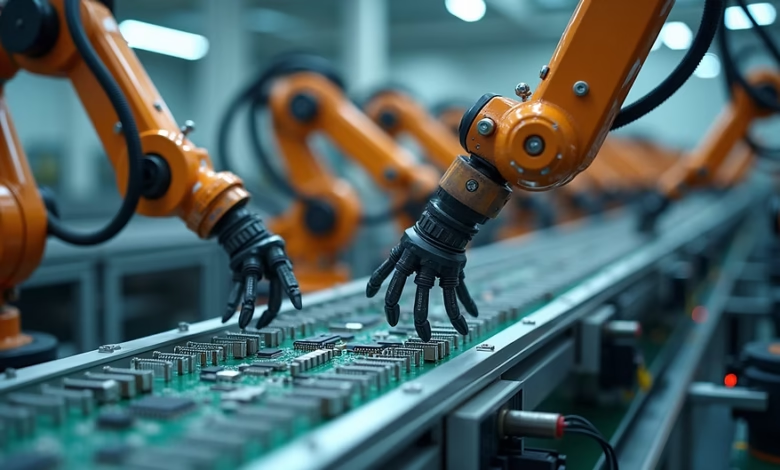
How Industrial Automation Improves Efficiency and Reduces Costs
What this is about
✔️ How automation actually reduces manual work and speeds things up on the production floor
✔️ Where companies start saving money — not just labor, but energy, downtime, and wasted materials
✔️ The core tech behind it all (things like sensors, PLCs, robotics, control systems) — and how they work together
✔️ A few real-world examples from manufacturing, packaging, and similar environments
✔️ What to expect in terms of ROI, plus some practical notes if you’re thinking about implementing automation
What Is Industrial Automation?
Industrial automation is the use of control systems to run machines and processes automatically, without constant human involvement.
- Uses control technologies to operate machinery automatically
- Includes components like PLCs, sensors, drives, robotics, and software systems
- Helps reduce manual work and improve consistency in production processes
In real industrial setups, companies often rely on solutions and components from providers like eltra trade to build and maintain efficient automation systems.
Industrial automation uses control systems and sensors to operate machinery with minimal human input, improving efficiency, accuracy, and consistency.
Why Automation Improves Efficiency
Automation makes a noticeable difference in how smoothly and quickly production runs. In most cases, the biggest improvements come from removing delays, reducing variability, and keeping systems running continuously.
- Faster production cycles
Machines can operate at consistent speeds without breaks, increasing overall output. - Consistent output quality
Automated systems follow the same parameters every time, which helps maintain uniform product quality. - Reduced human error
By minimizing manual intervention, automation reduces mistakes that can lead to defects or rework. - Continuous operation (24/7 capability)
Systems can run around the clock, maximizing productivity and reducing idle time.
Automation improves efficiency by increasing speed, consistency, and uptime across industrial processes.
How Automation Reduces Costs
One of the main reasons companies invest in automation is simple — it helps cut costs in multiple areas at once. The savings don’t just come from labor, but also from better control, fewer errors, and more efficient use of resources.
Labor Cost Reduction
- Fewer manual tasks
Repetitive work is handled by machines instead of operators. - Reduced dependency on operators
Fewer people are needed to run and monitor production lines.
Reduced Downtime
- Predictive maintenance
Systems can detect issues early and prevent unexpected failures. - Faster fault detection
Problems are identified and resolved more quickly, reducing stoppages.
Lower Waste and Scrap
- Precise control reduces defects
Automated systems maintain consistent parameters, minimizing errors. - Better process consistency
Stable production leads to fewer rejected products and less material waste.
Energy Optimization
- Smart control of motors and systems
Equipment runs only when needed and at optimal performance levels. - Reduced unnecessary consumption
Automation helps eliminate wasted energy during idle or inefficient operation.
In practice, these savings add up quickly, which is why automation often delivers strong ROI over time.
Key Technologies Behind Industrial Automation
Industrial automation is built on a combination of technologies that work together to control, monitor, and optimize processes. Each component plays a specific role in keeping systems efficient and reliable.
Sensors
- Detect position, presence, flow, temperature, and other process variables
- Provide real-time data to the control system
PLCs (Programmable Logic Controllers)
- Act as the core control system
- Handle process logic and decision-making based on sensor inputs
Drives and Motors
- Control speed, torque, and motion of machinery
- Essential for conveyors, pumps, and production equipment
Robotics
- Perform high-speed, repetitive tasks with precision
- Common in assembly, packaging, and material handling
SCADA / HMI Systems
- Provide monitoring and control interfaces
- Allow operators to visualize processes, adjust settings, and respond to alarms
Together, these technologies form the backbone of modern automation systems, enabling efficient and consistent industrial operations.
Real-World Examples of Efficiency Gains
Automation doesn’t just look good on paper — it delivers measurable improvements in real production environments. Here are a few common examples I’ve seen in practice:
- Packaging line → faster throughput with automated sensors
Sensors handle product detection and timing, allowing lines to run faster without manual intervention. - CNC machining → improved precision and reduced scrap
Automated control ensures consistent cutting accuracy, which significantly lowers material waste. - Conveyor systems → synchronized movement reduces bottlenecks
Encoders and sensors keep different sections of the system in sync, preventing jams and uneven flow. - Food production → consistent quality and reduced contamination
Automation minimizes human contact and maintains stable process conditions, improving both quality and hygiene.
Automation vs Manual Processes (Comparison Table)
When comparing automation to manual work, the difference becomes very clear once you look at real production performance. It’s not just about speed — it’s about consistency, predictability, and how well the system performs over time.
Here’s how automated systems compare to manual processes in real production environments.
| Factor | Automated Systems | Manual Processes |
| Speed | High, consistent production rate | Slower, depends on operator |
| Cost | Higher upfront, lower long-term | Lower upfront, higher ongoing |
| Accuracy | Very high, repeatable results | Variable, prone to human error |
| Downtime | Lower with predictive maintenance | Higher due to human delays/errors |
| Scalability | Easy to scale production | Difficult to scale efficiently |
While manual processes may seem more flexible at the beginning, they often become a bottleneck as production scales. Automation, on the other hand, delivers more stable performance and better long-term efficiency.
Automation usually requires a higher upfront investment, but it consistently outperforms manual processes in speed, accuracy, and reliability over
ROI of Industrial Automation (Why It Pays Off)
One of the biggest questions around automation is whether the investment is worth it. In most real-world cases, the answer is yes — but not because of one single factor. The return comes from a combination of improvements across the entire process.
- Initial investment vs long-term savings
Automation requires upfront investment, but over time the savings in efficiency and reduced losses outweigh the initial cost. - Reduced labor costs
Fewer manual tasks mean fewer operators are needed to maintain the same or higher production levels. - Increased production output
Automated systems can run faster and more consistently, increasing total output without adding more resources. - Lower maintenance costs
Predictive maintenance and better system control reduce unexpected failures and expensive repairs.
Automation often pays for itself through increased efficiency, reduced downtime, and lower operating costs.
Common Challenges When Implementing Automation
While automation brings clear benefits, getting there isn’t always straightforward. Most challenges come up during implementation rather than operation.
- High upfront cost
Initial investment in equipment, integration, and setup can be significant, especially for large systems. - Integration with existing systems
Connecting new automation with older equipment can be complex and may require custom solutions. - Training requirements
Operators and maintenance teams need to learn how to use and support new technologies. - Maintenance and support
Automated systems require ongoing monitoring, updates, and technical support to keep them running efficiently.
Understanding these challenges early helps plan better and avoid delays during implementation.
How to Start Automating a Process
Getting started with automation doesn’t have to be complicated. The key is to take a structured approach and focus on areas where automation will have the biggest impact.
- Identify repetitive tasks
Look for processes that are done manually over and over — these are usually the best candidates for automation. - Analyze cost vs benefit
Estimate how much time, labor, and resources can be saved compared to the investment required. - Select appropriate automation technology
Choose the right tools, such as sensors, PLCs, drives, or robotics, based on the specific task. - Integrate with existing systems
Make sure the new solution works smoothly with current equipment and control systems. - Test and optimize
Run the system, monitor performance, and fine-tune settings to achieve the best results.
Starting small and improving step by step is often the most effective way to implement automation successfully.
When Automation Makes the Biggest Impact
Automation delivers the greatest value in situations where consistency, speed, and safety are critical. These are the areas where manual work tends to struggle the most.
- High-volume production
When large quantities need to be produced, automation ensures consistent output and significantly increases throughput. - Repetitive processes
Tasks that are repeated continuously are ideal for automation, as machines can perform them faster and without fatigue. - Precision-dependent operations
In processes where accuracy is critical, automation helps maintain tight tolerances and reduces the risk of errors. - Hazardous environments
Automation improves safety by reducing human exposure to dangerous conditions such as high temperatures, chemicals, or heavy machinery.
In these scenarios, automation not only improves efficiency but also enhances reliability and workplace safety.
Engineer’s Perspective (Real Field Insight)
From what I’ve seen in real projects, automation works best when it’s approached with the right mindset — not as a quick fix, but as a way to improve how the whole system runs.
- “Automation isn’t about replacing people — it’s about removing inefficiencies.”
The goal is to eliminate repetitive, error-prone tasks and let people focus on more valuable work. - “Most savings come from reducing downtime, not just labor.”
In many cases, the biggest cost reductions come from keeping machines running consistently, not just cutting workforce. - “Start small — optimize one process before scaling.”
Final Checklist Before Implementing Automation
Before jumping into automation, it’s worth slowing down and thinking things through properly. A lot of projects run into trouble not because the technology is wrong, but because the basics weren’t clearly defined at the start.
- Define process goals
Be specific about what you’re trying to improve. Is it speed, product quality, cost reduction, or reducing downtime? In most cases, it’s a combination — but having clear priorities helps guide all decisions later. - Calculate ROI
Don’t just look at equipment cost. Factor in labor savings, reduced waste, improved uptime, and higher output. In real projects, ROI often comes from multiple small improvements adding up over time. - Evaluate current inefficiencies
Take a close look at where time, energy, or materials are being lost. Bottlenecks, manual handling, rework, and machine idle time are usually the best places to start. - Choose scalable solutions
Avoid solving just today’s problem. The system should be able to grow with production — whether that means higher throughput, additional lines, or more complex control later on. - Plan maintenance and support
Automation doesn’t eliminate maintenance — it changes it. Make sure there’s a plan for troubleshooting, spare parts, and ongoing support so the system stays reliable.
In real projects, the biggest difference comes from this stage.
When the planning is done properly, automation tends to run smoothly. When it’s rushed, problems show up later — usually when production is already depending on the system.
Taking the time upfront helps ensure that automation delivers consistent, long-term value, not just a short-term improvement.