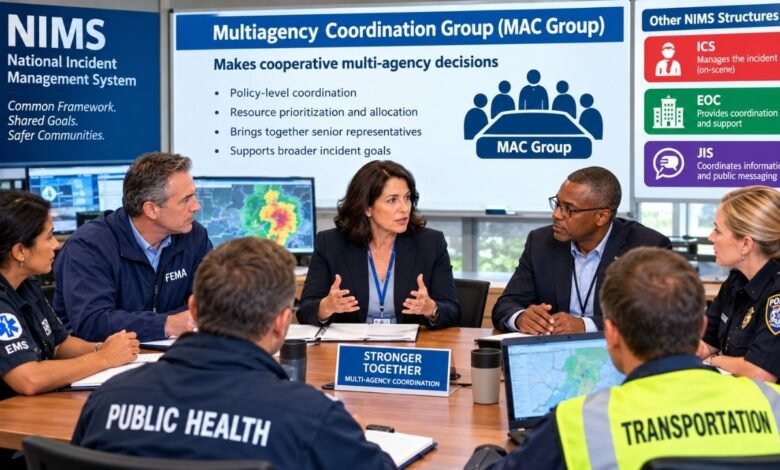
When several government agencies, organizations, and emergency-response teams are involved in the same incident, effective coordination becomes essential. A large emergency may require fire departments, law enforcement, emergency medical services, public health agencies, transportation departments, utility providers, nonprofit organizations, and other partners to work toward common goals. The National Incident Management System (NIMS) provides a standardized framework for coordinating these efforts.
One common NIMS training and examination question asks: Which NIMS structure makes cooperative multi-agency decisions? The correct answer is the Multiagency Coordination Group (MAC Group). FEMA training materials specifically identify MAC Groups as structures that make cooperative multi-agency decisions, support resource prioritization and allocation, and provide policy-level coordination during incidents.
Understanding why the MAC Group is the correct answer also makes it easier to distinguish it from other NIMS structures, including the Incident Command System (ICS), Emergency Operations Centers (EOCs), and the Joint Information System (JIS).
What Is NIMS?
The National Incident Management System (NIMS) is a standardized approach for managing incidents and coordinating resources and organizations. It provides common terminology, structures, processes, and principles that enable organizations at different levels and across disciplines to work together.
NIMS is designed to support incidents ranging from relatively small emergencies to complex disasters involving multiple jurisdictions and agencies. Its command and coordination structures help organizations understand their responsibilities while maintaining communication and coordination.
The major structures associated with NIMS command and coordination include the Incident Command System, Emergency Operations Centers, Multiagency Coordination Groups, and Joint Information Systems. Each has a different purpose.
Knowing these differences is particularly important for anyone studying NIMS or preparing for an emergency-management examination.
The Direct Answer: Multiagency Coordination Groups
If you encounter the question Which NIMS structure makes cooperative multi-agency decisions?, the answer is:
Multiagency Coordination Groups (MAC Groups).
FEMA’s NIMS training materials describe MAC Groups as part of the off-site incident management structure. They are sometimes called policy groups and generally consist of agency administrators, executives, or their designated representatives from stakeholder organizations.
Their role is not to take over tactical incident command. Instead, MAC Groups provide a higher-level coordination mechanism through which representatives can consider competing priorities, support resource decisions, and help align the actions of different organizations.
This distinction is the key to answering the question correctly.
What Is a Multiagency Coordination Group?
A Multiagency Coordination Group, or MAC Group, is a group of representatives from stakeholder agencies and organizations that helps coordinate high-level decisions during an incident.
Members are typically senior representatives such as agency administrators, executives, or their designees. Depending on the incident and jurisdiction, participants can come from different levels of government and from organizations such as emergency management, public health, critical infrastructure, private-sector entities, businesses, or volunteer organizations.
The composition of a MAC Group can therefore vary depending on the nature and scale of the incident.
For example, a major natural disaster could require representatives from local government, emergency management, public safety, public health, utilities, transportation, and other organizations. Bringing these stakeholders together can help establish common priorities and address resource challenges that affect multiple organizations.
Why Do MAC Groups Make Cooperative Decisions?
Emergencies frequently involve overlapping responsibilities. One organization may control a particular resource, while another is responsible for a different operational area. If each organization makes decisions independently, competing priorities can lead to delays or inefficient use of resources.
MAC Groups provide a forum for senior representatives to work together on these broader issues.
According to FEMA, MAC Groups act as policy-level bodies, support resource prioritization and allocation, make cooperative multi-agency decisions, and enable decision-making between elected or appointed officials and those responsible for managing the incident.
The word “cooperative” is especially important. A MAC Group is designed to bring multiple organizations into the same decision-making process rather than having each agency operate in isolation.
What Are the Main Functions of a MAC Group?
MAC Groups can perform several important functions during incidents.
Policy-Level Coordination
One of the primary roles of a MAC Group is providing policy-level guidance. The group helps senior officials and organizations consider the broader implications of incident-management decisions.
This is different from tactical command. MAC Groups do not direct individual responders in the field.
Resource Prioritization
Large incidents can create competition for limited resources. There may not be enough personnel, equipment, transportation capacity, specialized teams, or other resources to meet every request simultaneously.
MAC Groups can help prioritize and allocate scarce resources based on broader incident needs.
Multi-Agency Decision-Making
This is the function most directly connected to the keyword. MAC Groups provide a structure where representatives from multiple organizations can work together to make cooperative decisions.
Supporting Incident Leadership
MAC Groups can also help connect elected and appointed officials with those directly responsible for managing the incident. This helps maintain a relationship between policy-level leadership and incident-management personnel.
MAC Groups vs. Incident Command System
The Incident Command System (ICS) is one of the most important components of NIMS, but it is not the answer to the question about cooperative multi-agency decisions.
ICS provides a standardized structure for managing an incident. It is particularly associated with on-scene incident management and establishes functions, responsibilities, reporting relationships, and organizational structures.
A MAC Group operates differently.
The simplest distinction is:
- ICS: manages the incident.
- MAC Group: provides policy-level coordination and makes cooperative multi-agency decisions.
MAC Groups do not perform incident command functions. FEMA specifically states that they do not replace or take over the primary functions of operational organizations.
Understanding this difference prevents a common mistake on NIMS examinations.
MAC Groups vs. Emergency Operations Centers
An Emergency Operations Center (EOC) is another NIMS structure that can be confused with a MAC Group.
EOCs provide support and coordination for incident-management activities. They may collect and share information, coordinate resources, support planning, and help organizations respond to incident needs.
A MAC Group has a different emphasis. It operates at a policy level and helps senior representatives make cooperative decisions involving multiple agencies and organizations.
In other words, an EOC can support incident operations and coordination, while a MAC Group provides broader policy-level coordination.
The two structures can work together rather than competing with each other. FEMA explains that NIMS structures interface with one another to support effective incident management.
MAC Groups vs. Joint Information System
The Joint Information System (JIS) is another NIMS structure that has a distinct purpose.
JIS focuses on coordinating incident-related information and public messaging. It helps organizations provide consistent, coordinated information to the public and other audiences.
This makes JIS different from a MAC Group.
A simple comparison is:
- MAC Group: policy-level, cooperative multi-agency decisions.
- EOC: coordination and support for incident operations.
- ICS: on-scene incident management.
- JIS: coordinated public information and messaging.
Remembering these four functions can make many NIMS questions easier to answer.
How MAC Groups Support Resource Allocation
Resource management can become especially difficult during large or complex emergencies.
Imagine a major disaster affecting several communities. Multiple jurisdictions may need the same specialized equipment, personnel, transportation resources, or emergency supplies. There may be legitimate reasons for each organization to request those resources.
A MAC Group can help provide a broader perspective.
Rather than focusing solely on one organization’s needs, representatives can consider the overall incident and help establish priorities. FEMA identifies resource prioritization and allocation as an important MAC Group function.
This does not mean the MAC Group personally manages every resource. Instead, it supports high-level decisions about priorities and allocation.
Who Can Participate in a MAC Group?
MAC Group membership depends on the incident and jurisdiction.
Members are generally senior representatives from stakeholder agencies or organizations. These may include agency administrators, executives, or their designees.
Other organizations may participate when their responsibilities or resources are relevant to the incident. FEMA training materials note that MAC Groups can include representatives from nongovernmental organizations, including businesses and volunteer organizations.
MAC Groups may also be established at different organizational levels and across different disciplines.
This flexibility allows the structure to be adapted to the circumstances of the incident.
An Example of a MAC Group in Action
Consider a large wildfire that affects several communities.
Fire agencies may need additional firefighting resources. Emergency managers may be coordinating evacuations and shelters. Public health officials may be addressing smoke-related concerns. Transportation agencies may need to manage road closures and evacuation routes. Utility companies may be dealing with damaged infrastructure.
Each organization has its own responsibilities, but the incident creates shared challenges.
A MAC Group can bring senior representatives together to consider the overall situation. The group may help prioritize scarce resources, provide policy guidance, and coordinate decisions among participating organizations.
Meanwhile, ICS personnel continue to manage the incident, EOCs provide coordination and support, and the JIS coordinates public information.
This example demonstrates why the structures are complementary rather than interchangeable.
Why This Question Appears in NIMS Training
The question Which NIMS structure makes cooperative multi-agency decisions? tests whether a learner understands the different functions of NIMS command and coordination structures.
The wording is an important clue.
If a question asks about:
- Cooperative multi-agency decisions: think MAC Groups.
- On-scene incident management: think ICS.
- Off-site operational support and coordination: think EOC.
- Coordinated public information: think JIS.
FEMA’s training materials explicitly use the phrase “make cooperative multi-agency decisions” when describing MAC Groups.
Therefore, recognizing the terminology can make the correct answer much easier to identify.
A Simple Way to Remember the Answer
A useful memory aid is:
MAC = Multiagency Coordination = cooperative decisions.
When multiple agencies need to coordinate on high-level priorities, consider the Multiagency Coordination Group.
You can also remember the basic division of responsibilities:
ICS manages.
EOC supports.
MAC Group coordinates policy and decisions.
JIS communicates.
This simplified approach should not replace formal NIMS training, but it can be useful when reviewing concepts or preparing for a quiz.
Frequently Asked Questions
Which NIMS structure makes cooperative multi-agency decisions?
The Multiagency Coordination Group (MAC Group) makes cooperative decisions among agencies. FEMA identifies MAC Groups as policy-level bodies that support resource prioritization and facilitate decision-making among officials and incident management personnel.
Does a MAC Group perform incident command functions?
No. MAC Groups do not perform direct incident command functions. Their role is primarily policy-level coordination and support for broader decision-making.
What does MAC stand for in NIMS?
MAC stands for Multiagency Coordination. A MAC Group is the Multiagency Coordination Group.
Is an EOC the same as a MAC Group?
No. EOCs and MAC Groups have different functions, although they can interact during an incident. EOCs provide coordination and support, while MAC Groups operate at the policy level and support cooperative multi-agency decisions.
What is the difference between ICS and a MAC Group?
ICS provides the structure for managing an incident, while a MAC Group supports policy-level coordination, resource prioritization, and cooperative decisions among agencies and organizations.
Conclusion
The answer to which NIMS structure makes cooperative multi-agency decisions? is the Multiagency Coordination Group (MAC Group).
MAC Groups are part of NIMS’s off-site incident management structure and function primarily at the policy level. They bring together representatives from stakeholder agencies and organizations to support cooperative decision-making, resource prioritization, and coordination between senior officials and incident managers.
The most important distinction is that a MAC Group does not replace Incident Command, an EOC, or the Joint Information System. Each NIMS structure has its own purpose. ICS focuses on incident management; EOCs provide support and coordination; JIS focuses on coordinated information; and MAC Groups provide policy-level multi-agency coordination.
You May Also Read: How Can We Empower the Disaster Management Crew: Strategies for Stronger Emergency Response