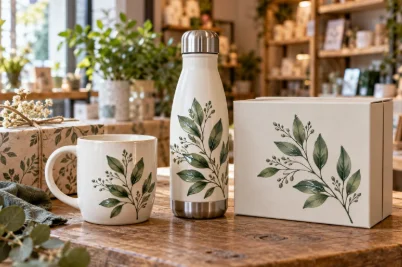
Consider a gift shop planning a small summer collection: a reusable bottle, a ceramic mug and a keepsake box with a smooth, rigid lid. This is a hypothetical buying brief. The shop wants the products to look related, but each has to earn its place on the shelf. Putting the same large design on all three would be easy to picture and rather less convincing to sell.
UV DTF offers one way to decorate suitable hard surfaces. The design is printed onto film and then transferred to the object, so the finished bottle or box does not have to pass through the printer. For a retailer, the useful question is how that production method can serve a coherent range: which designs stay fixed, what customers can change and how much decorated stock to hold.
Three objects in one visual family
A collection needs a shared idea, not necessarily a repeated layout. Suppose the theme is a group of garden plants. The mug could carry a fuller botanical arrangement, the bottle a narrow sprig and the box a small emblem on its lid. The colours and drawing style connect the objects even when their decoration sizes differ.
The bottle deserves particular attention. A design that looks balanced on a flat screen can disappear around its sides when seen from the front. A narrow design leaves room for a name and keeps the main image visible. On the mug, the handle changes where the decoration is seen and held. The box provides a flatter area, but a large lid does not oblige the shop to fill it.
These choices affect how the range is photographed as well as how it is made. One picture of the three objects together can establish the collection; individual pictures need to show the actual decoration size and position. A close-up of the artwork alone tells a shopper little about what they will receive.
There should also be a reason to buy each object. The mug might be the everyday purchase, the bottle the more substantial present and the box an optional way to package a gift. If the box costs too much to sit comfortably alongside the other pieces, it can be sold separately. A coordinated design does not require every customer to buy a set.
A name should not mean a complete redesign
Personalisation works best when the customer understands the choices. For this collection, the shop could offer one typeface, a choice of two text colours and one agreed name position per product. That is enough to make a gift personal without turning every order into a fresh design commission.
Long names expose the limits of a mock-up quickly. Shrinking every name to fit the same space can leave longer ones difficult to read. Before advertising the service, the shop should decide whether it will use a second line, a shorter agreed form or a different layout when a name exceeds the available area. The answer belongs in the product options, where the customer can see it.
A business logo is a different kind of request. It may need a separate layout, permission to reproduce the mark and a proof showing its position. A retailer can still use a familiar bottle, but it should quote the work as a custom order rather than squeeze it into a standard name option. Customer-supplied artwork that needs redrawing, or lettering too fine for the agreed size, also needs a separate discussion.
The order form can remain brief. It needs the exact text, the selected product and design option, the collection or delivery date, and a clear point after which changes are chargeable. A customer buying a birthday gift usually needs to know whether it will be ready in time before they need a detailed explanation of the printing process.
Stock blanks before choosing the decoration
Decorating every bottle with a seasonal motif commits the whole batch to that design. Keeping some as undecorated blanks leaves the shop a choice between the summer collection, a named gift and a business order. This only works if the blanks themselves are useful across those offers. Buying several unfamiliar shapes simply because they can be personalised can produce a cupboard full of slow-moving stock.
For the hypothetical range, a sensible starting assortment might use one bottle shape, one mug and one box size. Colour choices matter too. A pale botanical motif may be clear on a dark bottle but almost disappear on a light one; the design should be reviewed on the actual product rather than approved only against a screen background. A finished example also shows the retailer whether the surface and decoration combination is suitable.
Production does not have to happen in the shop. A print service can supply finished pieces or compatible printed transfers, depending on who will apply them and take responsibility for the result. If the retailer later considers bringing printing in-house, XINFLYING’s range of UV DTF printers for custom products is a relevant equipment reference. The useful brief is the assortment, its usual order sizes and the work someone will handle each day. A wide catalogue of possible applications is less helpful than knowing what the shop actually intends to sell.
What the shelf needs to say
The display should make the offer understandable without a long conversation. Show which items are sold separately, which can carry a name and what a matching set includes. A sample can sit beside an undecorated version so customers can see the choice, but the price label should leave no doubt about whether personalisation is included.
Keep the visible range edited. Three coordinated pieces with clear options are easier to compare than a crowded display of unrelated objects. A small printed card can show another colour or layout without requiring a decorated example of every combination. For online sales, photographs of finished items should lead; a clearly labelled mock-up can illustrate a proposed variation without masquerading as a product already made.
The practical information can be equally concise. Give care instructions supported by the particular blank and decoration combination, rather than making a blanket dishwasher-safe claim. On drinkware, keep decoration away from the rim and internal contact surfaces unless documentation supports that use. Pack the pieces so decorated faces do not rub together, especially if a mug and bottle share one gift box.
Before adding another object, ask what it contributes to the collection. A second bottle with a slightly different shape may add stock without offering a useful choice. A smaller matching item might make more sense as an additional gift, provided it is straightforward to decorate and package. The range is ready to grow when a new piece has a clear role of its own, not simply an empty surface for another copy of the design.