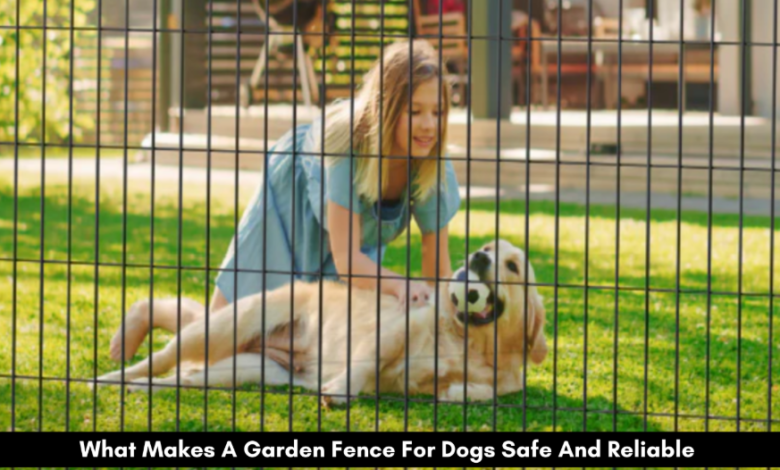
Letting your dog play in the yard should be comforting, but it often makes you anxious. You can be concerned that your dog is going to squeeze through the crack, push against weak fencing, or jump over low fences in search of something outside the yard.
Consequently, the play time outside might be spent with constant surveillance instead of relaxing. When the fence is not reliable, you might continue to examine the fence and make sure it does not have gaps or damage, rather than trusting it to keep your dog safe.
However, an effective fence may resolve these issues by developing a formidable and reliable boundary. The fence that has strong materials, stable construction, and the right height, prevents escapes while allowing your dog to move freely.
Moreover, smart design solutions enhance the visibility and durability. As a result, your garden turns into an area where your dog can roam safely. This article discusses the main factors that make a dog-friendly garden fence safe and secure.
1. Strong Boundary Structure
All safe yards begin with a strong and well-defined boundary. Dogs are curious animals, and thus they tend to check weak points in a fence line. Moreover, in case of any gaps or loose areas, your dog might manage to make its way through.
That is why structural strength should be the primary consideration when installing a garden fence for dogs. For example, welded mesh panels offer a degree of uniformity in durability due to the fact that every intersection of all the wires is firmly secured. Hence, the mesh remains in place despite dogs pushing or leaning on it.
Moreover, the panels are aligned with the help of evenly spaced posts and strong connectors. Due to this support system, the fence forms a single, continuous barrier and not individual fragments that can shift over time. Consequently, you have a reliable perimeter that can keep your dog safe.
2. Durable Materials and Weather Resistance
The long-term reliability is dependent on the materials used in fencing. Outdoor fences are subject to constant change due to rain, sun, and temperature. With time, the weaker materials can rust or become worn out.
That is why durable steel mesh is a common item in reliable fencing systems. High-tensile steel can withstand tending and stays strong even when dogs keep pushing against it repeatedly.
Moreover, coating protective materials prevents corrosion induced by moisture. Such a coating preserves the look and the structural integrity of the fence. As a result, the fence remains functional in various seasons without the need to be repaired regularly.
3. Reinforced Panel Design
In addition to strong materials, reinforced panels add another level of protection. Dogs that jump or lean against fencing can gradually weaken thin mesh panels.
To prevent this issue, many fencing systems include V-bend reinforcements across the panels. These bends distribute pressure evenly, which improves overall rigidity.
Because of this reinforcement, the fence becomes far more resistant to bending or distortion. Even energetic dogs are less likely to damage the structure. Therefore, reinforced panels help maintain stability along the entire fence line.
4. Proper Fence Height for Escape Prevention
Equally important, fence height plays a major role in preventing escapes. Many dogs can jump higher than expected, especially when excited or curious.
Furthermore, a taller fence reduces this risk by creating a barrier that discourages jumping. For example, heights between approximately 1.14 meters and 1.71 meters often provide reliable containment for many breeds.
Moreover, taller fences create a clear visual boundary. Once dogs recognize that the barrier is too high to cross, they usually stop attempting to jump. As a result, the correct fence height strengthens the overall security of your yard.
5. Open Mesh Visibility for Pet Comfort
While strength is essential, comfort also matters for dogs spending time in the yard. Solid barriers may block outside views, which can increase curiosity or frustration.
By contrast, open mesh fencing allows your dog to see the surrounding environment. This visibility keeps pets mentally engaged while they remain safely contained.
At the same time, the mesh design allows you to monitor your dog easily from different areas of the yard. Therefore, open mesh fencing creates a balance between security and comfort.
6. Secure Gates and Complete System Integration
Gates must match the strength of the surrounding fence. Entry points experience frequent movement, which makes them vulnerable if not properly built.
Therefore, a reliable system includes strong hinges, secure latches, and tightly fitted gate frames. As a result, these features prevent gaps from forming around the gate area.
In addition, proper installation ensures that the gate aligns with the rest of the fence structure. When every component works together, the fence functions as a unified system. Consequently, your dog remains safely enclosed while you maintain easy access to the yard.
Bottomline
A reliable garden fence provides more than a simple property boundary. Instead, it creates a secure outdoor space where your dog can move freely without the risk of escaping. When you combine durable materials, reinforced panels, and appropriate height, the fence becomes strong enough to handle both environmental conditions and daily pet activity.
At the same time, features such as open mesh visibility and secure gates improve comfort and usability. Because these elements work together, the fence maintains consistent protection across the entire yard. Ultimately, a well-built fence allows you to enjoy your outdoor space with confidence while ensuring your dog remains safe within it.