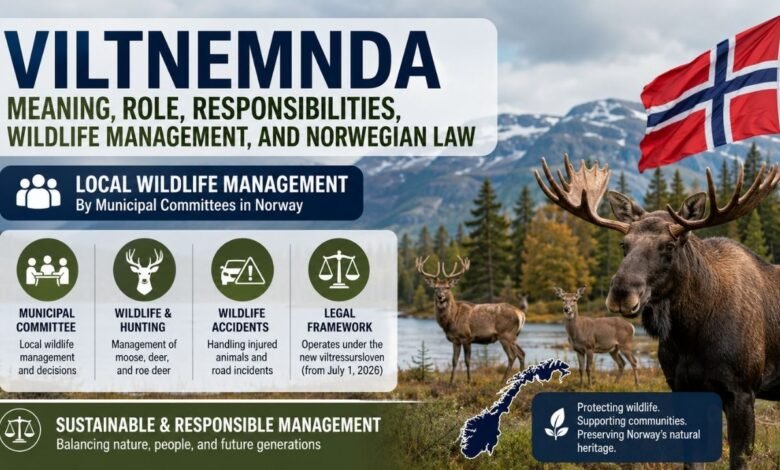
Viltnemnda is a Norwegian term connected to local wildlife management, hunting, game populations, and the administration of wildlife resources. For people unfamiliar with Norwegian terminology, the word can be confusing because it does not necessarily refer to one single national organization. Instead, viltnemnd describes a committee or administrative arrangement involved in the municipal aspect of wildlife management.
The Norwegian Bokmålsordboka defines viltnemnd as a municipal committee responsible for wildlife management. The definite form viltnemnda can therefore be understood in English as “the wildlife committee” or, depending on context, “the municipal wildlife management committee.”
Wildlife management is an important part of Norway’s environmental and rural administration. It involves questions concerning wild animals, hunting, population management, animal welfare, road accidents involving wildlife, damage caused by game, and sustainable use of wildlife resources.
This article explains what viltnemnda means, what role it can play, how municipal wildlife management works, its connection with hunting and large game, and how the new Norwegian viltressursloven affects the legal framework from 2026.
What Does Viltnemnda Mean?
The word viltnemnda comes from the Norwegian term viltnemnd.
The Norwegian dictionary defines viltnemnd as a kommunal nemnd som driver viltforvaltning, meaning a municipal committee that manages wildlife. The dictionary lists viltnemnda as the definite feminine form, while viltnemnden is another grammatical form.
In simple terms, the word refers to a local body responsible for managing wildlife-related matters.
A useful English translation can be:
- Wildlife committee
- Municipal wildlife committee
- Wildlife management committee
- Local game management committee
The exact translation depends on the context in which the Norwegian word is used.
What Is the Role of Viltnemnda?
The role of a viltnemnd is connected to municipalities’ responsibilities in wildlife management.
Store norske leksikon describes viltnemnder as committees that handle the municipality’s wildlife management responsibilities. It also notes that Norwegian municipalities have developed different administrative and political models for organizing local wildlife management.
This means that people should not automatically assume that every municipality has an identically structured body officially named “Viltnemnda.”
Depending on the municipality, wildlife responsibilities can be organized through a dedicated wildlife committee, another municipal committee, or an administrative arrangement.
Viltnemnda and Municipal Wildlife Management
Municipalities play an important role in Norway’s wildlife management system.
Local wildlife management is particularly important because wildlife populations and human activities interact differently in different areas. A municipality may have to consider forests, farmland, roads, hunting areas, residential development, conservation concerns, and local animal populations.
The Landbruksdirektoratet explains that municipalities act as local wildlife authorities in the management of large game such as moose, red deer, and roe deer. Management involves monitoring populations and regulating them through hunting.
This local approach allows wildlife management to take into account on-the-ground conditions rather than relying exclusively on decisions made at the national level.
Historical Background of Viltnemnda
The history of the term is also important.
According to Store norske leksikon, Norway had state wildlife committees in all municipalities from 1952 to 1992. Municipal councils appointed these committees. On January 1, 1993, local wildlife administration was transferred to the municipalities. Since then, municipalities have used various administrative and political models to organize wildlife management.
This historical development helps explain why the modern meaning of viltnemnd should not necessarily be treated as a single standardized national agency.
Instead, the concept is closely connected with local government and municipal responsibility.
Viltnemnda and Hunting in Norway
Hunting is one of the most visible parts of wildlife management in Norway.
Responsible hunting can help regulate wildlife populations while also providing opportunities for recreation and the sustainable use of natural resources.
The management of species such as moose, red deer, and roe deer depends on monitoring wildlife populations and assessing factors such as population size, available food, damage to forests and agricultural land, and traffic accidents involving animals.
Therefore, local wildlife management can directly affect hunters, landowners, farmers, motorists, and people living in areas with significant wildlife populations.
However, it is important to distinguish between viltnemnda as a local wildlife-management concept and the wider Norwegian system of hunting regulation. Hunting is governed by national legislation and regulations as well as local administrative decisions.
Viltnemnda and Moose, Deer, and Roe Deer
Large game, commonly known in Norwegian as hjortevilt, is particularly important in wildlife management.
The main species include:
- Elg — moose
- Hjort — red deer
- Rådyr — roe deer
The Landbruksdirektoratet states that management of these populations is based on monitoring and that populations are regulated through hunting. Municipalities facilitate this management as local wildlife authorities.
Large wildlife populations can create both ecological and practical challenges.
For example, large populations may contribute to:
- Vehicle collisions with wildlife
- Grazing damage to forests
- Damage to agricultural land
- Pressure on available food
- Conflicts between wildlife and human activity
Consequently, wildlife management is not simply about allowing or preventing hunting. It involves balancing population health, animal welfare, environmental considerations, public safety, land use, and sustainable hunting.
Wildlife Accidents
Another important part of local wildlife management concerns animals injured outside ordinary hunting activity.
Wildlife accidents can happen when animals such as moose or deer are hit by vehicles. These incidents can pose serious safety risks to motorists and cause unnecessary suffering to injured animals.
Norwegian government documents explain that municipalities have responsibilities concerning the search for and, when necessary, humane killing of wildlife that is sick or injured outside hunting. The new viltressursloven contains relevant provisions that took effect on July 1, 2026.
This demonstrates why local wildlife administration matters beyond hunting.
A municipal wildlife system can be involved in responding to wildlife incidents, coordinating searches, dealing with injured animals, and ensuring that wildlife-related responsibilities are handled appropriately.
The New Viltressursloven and Viltnemnda
One of the most important developments for anyone researching viltnemnda in 2026 is Norway’s new wildlife legislation.
The viltressursloven, officially the law concerning hunting, trapping, and killing of wildlife, entered into force on July 1, 2026. It replaced the 1981 wildlife law. The Norwegian government says that the new law largely continues existing legal principles while also updating and clarifying the framework for modern wildlife management.
The new legislation is designed to provide clearer rules for hunting, trapping, and wildlife management while addressing modern challenges.
The government describes the sustainable and responsible management of hunting, trapping, and killing wildlife as a central principle of the new framework. The law operates alongside other legislation, including rules concerning biodiversity and animal welfare.
For anyone searching for viltnemnda meaning or viltnemnda responsibilities, this legal change is important because municipalities’ and other authorities’ responsibilities should now be understood within the updated legal framework.
Why Is the Viltressursloven Important?
The previous Norwegian wildlife law dates from 1981. Wildlife management has changed considerably since then.
Technology has advanced, wildlife populations have changed, traffic has increased, and society’s expectations regarding animal welfare and sustainable resource management have evolved.
The government states that the new viltressursloven addresses modern issues, including technological tools that were not relevant when the old law was developed.
The law also provides a framework for sustainable hunting and wildlife management and takes Norway’s international obligations into account.
For local wildlife authorities, this means that current information about viltnemnda should be considered alongside the rules and regulations that became effective in 2026.
Is Viltnemnda a National Organization?
No, not in the sense of one single nationwide organization.
This is one of the most important points to understand about the keyword viltnemnda.
A person searching for the term might expect to find a single central government agency with a national office, a website, and a fixed membership. However, the term is primarily associated with local or municipal wildlife management.
Store norske leksikon explains that viltnemnder handle the portion of wildlife management for which municipalities are responsible, and notes that municipalities use different organizational models.
Therefore, if someone wants to contact “viltnemnda,” they may need to identify the relevant municipality first.
How Is Local Wildlife Management Organized?
There is no single organizational structure that applies identically to every municipality.
A municipality can decide how to organize its local wildlife-management responsibilities within the applicable legal and administrative framework.
In some cases, wildlife issues may be handled by a specific committee. In other cases, responsibility may be assigned to another municipal committee or administrative unit.
This distinction is important for anyone searching online for:
- Viltnemnda contact
- Viltnemnda kommune
- Viltnemnda phone number
- Viltnemnda email
- Viltnemnda application
- Viltnemnda responsibilities
The correct contact will generally depend on the municipality involved.
Viltnemnda vs. Other Wildlife Authorities
Norway’s wildlife management system includes several levels and types of authorities.
The term viltnemnd should not be confused with rovviltnemnd, which concerns large carnivores and is part of environmental administration. Store norske leksikon explains that regional rovviltnemnder are part of environmental management and operate under the Ministry of Climate and Environment, with the Statsforvalteren providing secretariat and advisory support.
There are also specialized bodies associated with the management of wild reindeer.
Therefore, terms such as:
- Viltnemnd
- Rovviltnemnd
- Villreinnemnd
can refer to various parts of Norway’s wildlife management system.
Understanding the distinction can prevent confusion when researching wildlife policy, hunting rules, or local authorities.
Why Wildlife Management Matters in Norway
Norway has extensive forests, mountains, agricultural areas, wetlands, and other natural habitats supporting diverse wildlife.
Wildlife management is necessary because animal populations live in landscapes that people use as well.
A healthy wildlife-management system aims to consider several interests simultaneously.
These can include:
Wildlife conservation: Populations need suitable habitats and sustainable management.
Animal welfare: Injured or suffering animals may require appropriate intervention.
Public safety: Large animals near roads can create dangerous traffic situations.
Agriculture: Wildlife can cause damage to crops and farmland.
Forestry: Browsing by deer and other animals can affect forests.
Hunting: Hunting traditions and sustainable harvesting remain important parts of Norwegian culture.
Biodiversity: Wildlife management needs to operate within broader environmental objectives.
This balance explains why municipal wildlife administration can be complicated.
Frequently Asked Questions About Viltnemnda
What does viltnemnda mean?
Viltnemnda is the definite form of the Norwegian term viltnemnd. It refers to a municipal committee or local administrative body involved in wildlife management. The Norwegian dictionary defines viltnemnd as a municipal committee responsible for wildlife management.
What does a viltnemnd do?
A viltnemnd deals with wildlife-management responsibilities assigned to the municipality. Depending on the municipality’s organization, this can involve matters related to wildlife populations, hunting, wildlife damage, and other local wildlife issues.
Is Viltnemnda a government agency?
It is better understood as a local or municipal wildlife-management body rather than a single national agency. Municipalities can organize their wildlife responsibilities in different ways.
Does Viltnemnda manage hunting?
Wildlife management and hunting are closely connected, particularly when hunting is used to regulate large-game populations. However, hunting in Norway is governed by national legislation and regulations as well as local administration.
What animals are involved in wildlife management?
Important game species include moose, red deer, and roe deer. Wildlife management can also involve other wild animals depending on local conditions and legal responsibilities.
Conclusion
Viltnemnda is an important Norwegian wildlife-management term that refers to local or municipal responsibility for managing wildlife-related matters. Although the word may resemble the name of a national organization, its meaning is more closely associated with municipal wildlife administration.
You May Also Read: Severna Dakota: North Dakota’s History, Economy, Attractions, and Lifestyle