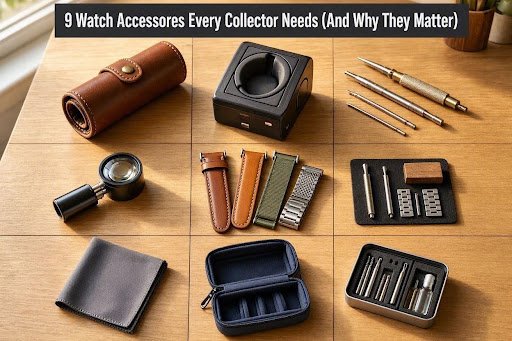
If you’ve spent any real money on a mechanical or automatic watch, the piece itself is only half the story. How you store it, wind it, and maintain it over the years determines whether it still runs beautifully in a decade — or ends up sitting in a drawer needing an expensive service. Below are the accessories that actually make a difference, starting with the ones people underestimate the most.
1. A Proper Watch Winder
Automatic watches rely on wrist movement to stay wound. If you own more than one and rotate between them, any watch sitting idle for a few days will stop and need resetting — which is a genuine annoyance for pieces with a perpetual calendar or moon phase complication that’s fiddly to reset.
A quality winder solves this by mimicking natural wrist motion, keeping the mainspring wound and the lubrication distributed evenly through the movement. This matters more for certain brands than others; Omega automatics, for example, have specific rotation and direction requirements depending on the calibre. If you’re shopping for one, it’s worth reading a guide like the best watch winders for Omega watches before buying, since the wrong turns-per-day setting can do more harm than good over time.
2. A Watch Valet Tray
This is the accessory people buy last and wish they’d bought first. A valet tray isn’t just storage — it’s the daily ritual point where your watch, wallet, cufflinks, and keys land at the end of the day instead of scattering across a dresser.
Beyond the convenience, a proper tray protects the crystal and case from scratches caused by keys or coins knocking against them in a drawer. If you’re setting up a nightstand or dresser setup and want something that looks intentional rather than thrown together, it’s worth browsing options that organise your everyday carry properly rather than improvising with a bowl.
3. Microfiber Cleaning Cloths
Fingerprints and dust build up fast on a polished case and crystal, and wiping them off with a shirt sleeve is one of the fastest ways to introduce fine scratches into a mirror-polished surface. A proper microfiber cloth, ideally one designed for watches or eyewear, removes oils and dust without abrasion.
Keep one in your travel case and one at home. It takes ten seconds and genuinely extends the life of the finish.
4. A Watch Case or Roll for Travel
Throwing a watch into a suitcase pocket next to a phone charger is asking for a scratched bracelet or a knocked crown. A padded travel roll or case keeps each piece separated and cushioned, which matters even more if you’re carrying two or three watches for a trip.
Leather rolls are compact and look sharp if you’re going through airport security often, while a hard case offers more protection if you’re checking luggage.
5. Watch Straps in Multiple Materials
One watch, several straps, completely different personality. Swapping between a leather strap for the office and a rubber or NATO strap for the weekend is one of the easiest ways to get more use out of a single piece without buying another watch.
It also has a practical side: leather straps shouldn’t get wet, so if you swim or work outdoors regularly, a rubber alternative saves the leather strap from premature cracking.
6. Silica Gel Packs for Storage
Moisture is the quiet enemy of any watch that isn’t being worn regularly. Whether it’s stored in a drawer, a safe, or a display case, humidity can fog up a crystal from the inside or, worse, encourage corrosion on movement components over years of storage.
Dropping a few silica gel packs into your storage box or safe is inexpensive insurance, especially in humid climates or coastal areas.
7. A Loupe for Inspection
You don’t need to be a watchmaker to benefit from a jeweler’s loupe. A 10x loupe lets you check for hairline scratches, inspect a bezel or crystal before buying a pre-owned piece, or simply appreciate finishing details like Geneva stripes or perlage that are invisible to the naked eye.
If you’re buying watches secondhand, this is arguably one of the most useful few pounds you’ll ever spend, since it can reveal repairs or damage that photos hide.
8. A Watch Tool Kit for Basic Adjustments
Sizing a metal bracelet, swapping a strap, or adjusting a clasp doesn’t require a watchmaker’s workshop — just the right small tools. A basic kit with spring bar tools, a case back opener, and a link removal pin covers most day-to-day adjustments.
This saves both time and the cost of a jeweler’s callout fee for something as simple as removing a link after losing a bit of weight.
9. A Dedicated Watch Safe or Lockbox
For anything beyond one or two pieces, a proper safe isn’t overkill — it’s common sense. Beyond theft protection, a good safe with built-in humidity control protects against the same moisture issues mentioned earlier, and many models now include slots for a winder to sit inside the safe itself, combining protection and function in one unit.
If you’re building a collection with any real value attached, insurance providers will often ask about secure storage anyway, so this tends to pay for itself.
Getting Started
You don’t need all nine of these at once. If you’re just starting to build a collection, prioritize a winder if you own more than one automatic, a tray for daily use, and a decent cloth. Everything else can be added as the collection — and the habit of caring for it — grows.
For a broader look at automatic movement maintenance and why winding matters mechanically, WatchTime’s guide to automatic movements is a solid technical resource worth reading.
If you’re ready to look at winders and accessories properly rather than piecing things together, it’s worth taking a look at what’s available directly from Aevitas UK, since their range is built specifically around collectors rather than general accessory shoppers.
Final Thoughts
None of these accessories are about excess or showing off — they’re about protecting something you’ve already invested in. A £50 valet tray or a well-chosen winder is a small cost next to a watch that costs hundreds or thousands of pounds, and the payoff is a collection that stays in genuinely good condition rather than needing repairs down the line.
Start with whichever gap in your current setup causes you the most friction day to day, and build from there.
FAQs
Do I need a watch winder if I only own one automatic watch?
Not necessarily. If you wear it daily, your wrist movement keeps it wound naturally. A winder becomes useful once you own multiple automatics and rotate between them, or if you don’t wear your watch for days at a time.
How often should I clean my watch?
A quick wipe with a microfiber cloth after each wear is ideal. A deeper clean, including the bracelet or strap, is worth doing every few weeks depending on how often you wear it and your environment.
Can I store different watches together in one box?
Yes, as long as they’re separated by cushioned compartments so cases and crystals don’t knock against each other. A shared box without dividers risks scratches over time.
Is it worth buying a winder for a quartz watch?
No. Quartz watches run on a battery, not a mainspring, so a winder serves no purpose for them. Winders are specifically for automatic and mechanical movements.
What’s the biggest mistake new collectors make with storage?
Ignoring humidity. A watch can look fine sitting in a drawer for months while moisture quietly affects the movement or fogs the crystal from the inside. Basic silica gel packs or a proper safe largely prevent this.